
PLATURN
45 Is The Magic Number
BY Sam Cohen
When DJing went digital in the mid-2000s, and vinyl fell out of favor on the dancefloor, Iceland-native DJ Platurn decided to throw a party to celebrate the 45 rpm 7-inch format.
What started as a get-together among vinyl-admiring friends has turned into the 45 Sessions–‘the West Coast’s premiere all-45 RPM outlet.’ Platurn helped restore 45s’ status as an iconic DJing medium because he devoted the better part of his career to being a vinyl DJ.
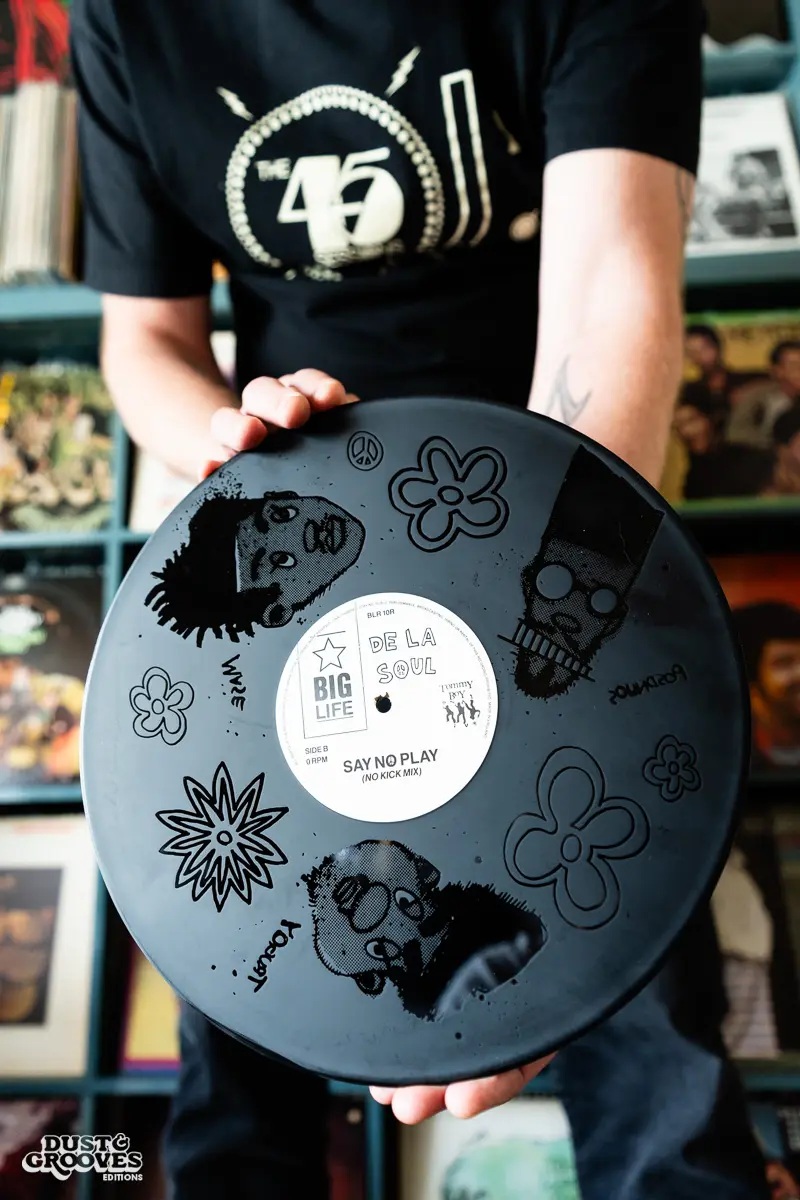
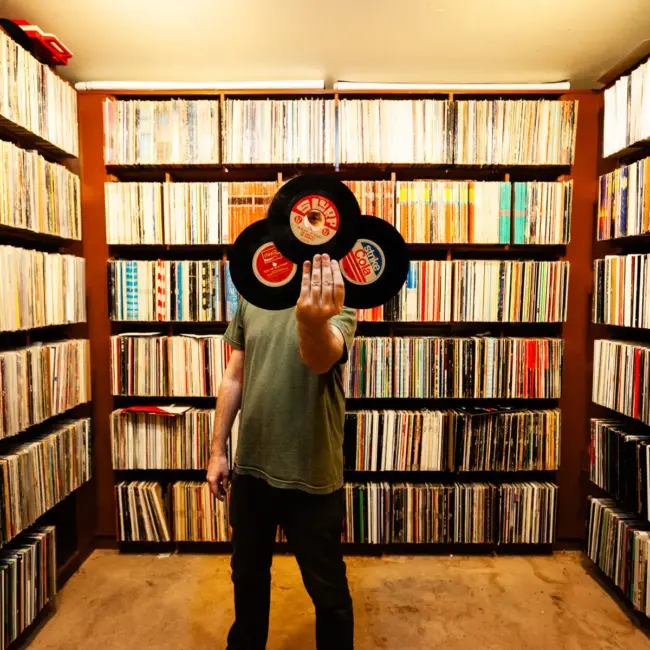
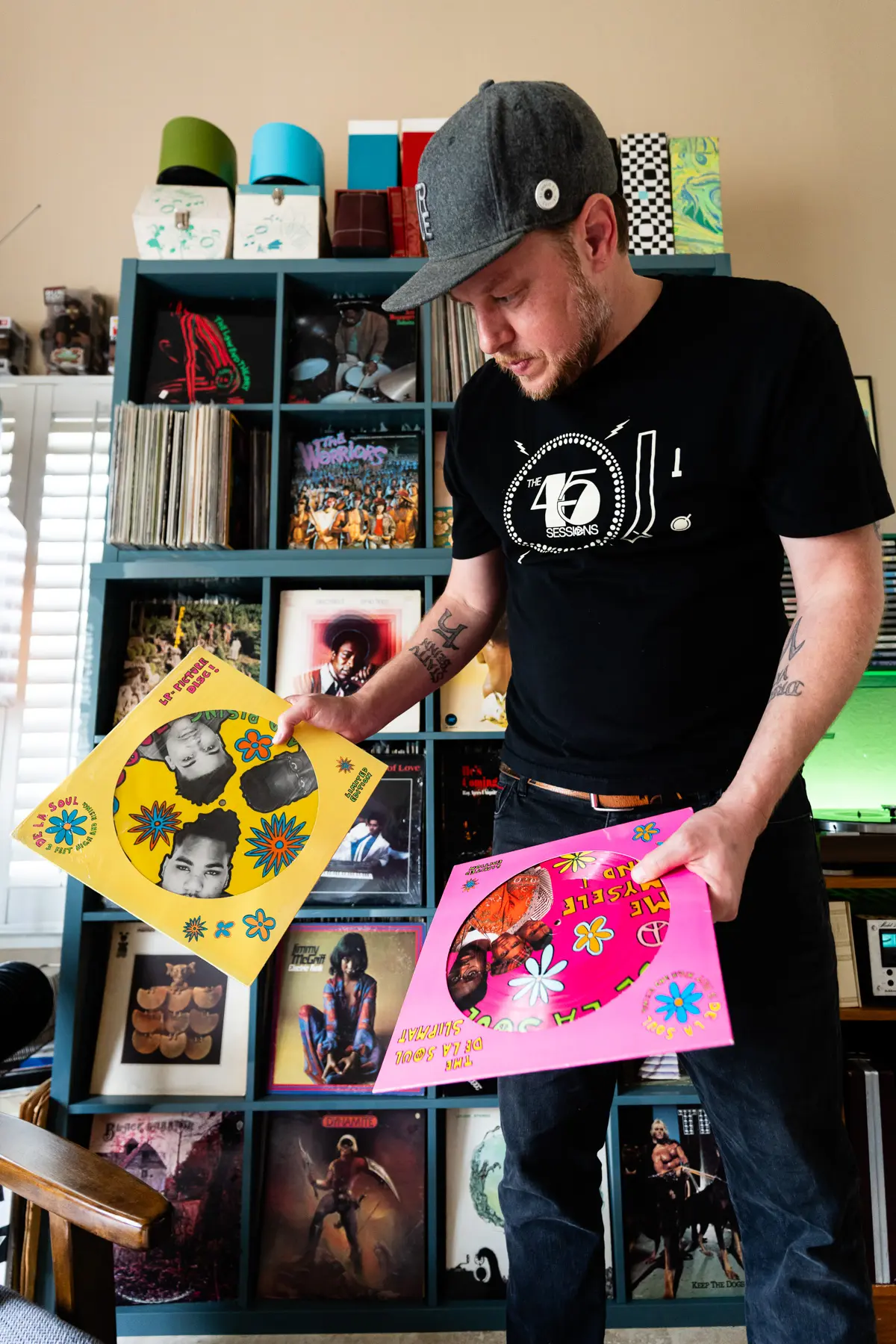
Anyone can tell his vinyl-attraction relies on the 7-inch; his studio walls are lined with perfectly square slots to fill with Curtom, Stax, and Polydor 45s that his Native Tongues icons pillaged for samples. The various offspring of the Native Tongues camp, particularly De La Soul, were some of the first things Platurn pursued on vinyl.
After hearing De La for the first time at a youth club in Iceland, everything changed for Platurn. They taught him that rap didn’t have to sound like Run DMC or Eric B. & Rakim–rap could be experimental and fun. His admiration for De La led to spinning alongside Prince Paul and Platurn’s seminal So This Is De La Heaven mix. De La Heaven let its tracks play in full and samples breathe, initiating a genre of artist-focused mixes, which many of his counterparts would experiment with.
Platurn, born in Iceland, moved to the Bay Area when he was seven, but he never dropped his connection to the Motherland. After years of digging in Iceland for a particular funk-infused classic rock sound, he released Breaking The Ice, the dopest mix of Icelandic deep cuts. The mix is not only a homage to his homeland, but an exploration of why small island countries like Iceland offer some of the world’s most distinctive sounds.
With a large cup of coffee for breakfast, we sat down with Platurn as he shared his thoughts on the current state of vinyl collecting and got deep about the artists who stayed with him from Stykkishólmur (his hometown in Iceland) to the Bay.
“If you are really nerdy about music and start diving into stuff, you realize that there's a wide array of personalities and interesting things in all genres of music.”
—Platurn
What kind of music were you drawn to growing up?
I don’t think there was a genre I didn’t touch growing up. My dad was a radio disc jock, so he was a huge music fan. He and my mom loved everything: classic rock, reggae, jazz, classical, the whole nine. You would hear everything imaginable in my household.
When I began forming my own opinions about music and art, I gravitated heavily toward Hip-Hop, especially the Native Tongues camp. If you wanted something a little harder and more aggressive, the Native Tongues was the movement at the time. Once I became more of a student of music, I shifted a little bit over time and got into funk, soul, jazz, RnB, and all of that.
My taste came along in and after high school, when I was working, and starting to become a DJ with an actual personality. There are really few genres that I’m like, “No, no, no, no. I don’t mess with that.” If you are really nerdy about music and start diving into stuff, you realize that there’s a wide array of personalities and interesting things in all genres of music.
For those who don’t know, how would you describe the Native Tongues camp, which includes De La Soul, A Tribe Called Quest, and Queen Latifah, to name a few?
To continue reading this interview we humbly ask you to consider supporting Dust & Grooves by becoming a paying premium member.
They were a collective of hip-hop artists and groups who were dramatically different from what was known as traditional and coveted hip-hop at the time. There was a staple and a distinct set of elements that rap was ‘supposed’ to sound like at that time. The Native Tongues were different; they were more experimental. Experimental, in terms of melody, sound beds, and the samples that were being chosen.
What they rapped about, the way they rapped, and their general messaging were far from what people were expecting from rap music at the time. It’s definitely one of those movements that could have gone one way or another.
Journalists and fans of that era loved to label them as rap hippies and call them weird or eccentric, but they were just being unapologetically themselves. I never looked at them like that; I just look at the fact that they weren’t afraid to try some diverse shit.
Your love for the Native Tongues led to the creation of the mix, So This Is De La Heaven (2004). Why the focus on De La Soul, and what can you tell me about compiling the mix?
There was just a particular thing about De La; they were offspring of the whole Native Tongues movement, which I was really attracted to at the time. The early Native Tongues material started when I moved to Southern California, and the sound and samples were so on par with the style I familiarized myself with. My history with the group and genre made choosing De La a natural thing for me to want to do and focus on.
It probably took me a year or two to source all the material you hear on part one. The mix is all pre-digital, too. It was all original records and recorded on a six-track or something like that. I was finding the material while making it, and all the mixing had to be done live.
Sometimes, you put your head into something you are clearly passionate about, and it becomes your world musically, and it ends up being so serious for you. With the second one, I had to uphold that same ethos; I had to be adamant about making sure it was equally as good, if not better, than the first one.
“The youth club I went to in Iceland had a copy of 3 Feet High And Rising, and my cousin was like, ‘Dude, you gotta hear this.’ When De La was first marketing the album, a really big portion of their fan base was ‘east of the East Coast.’”

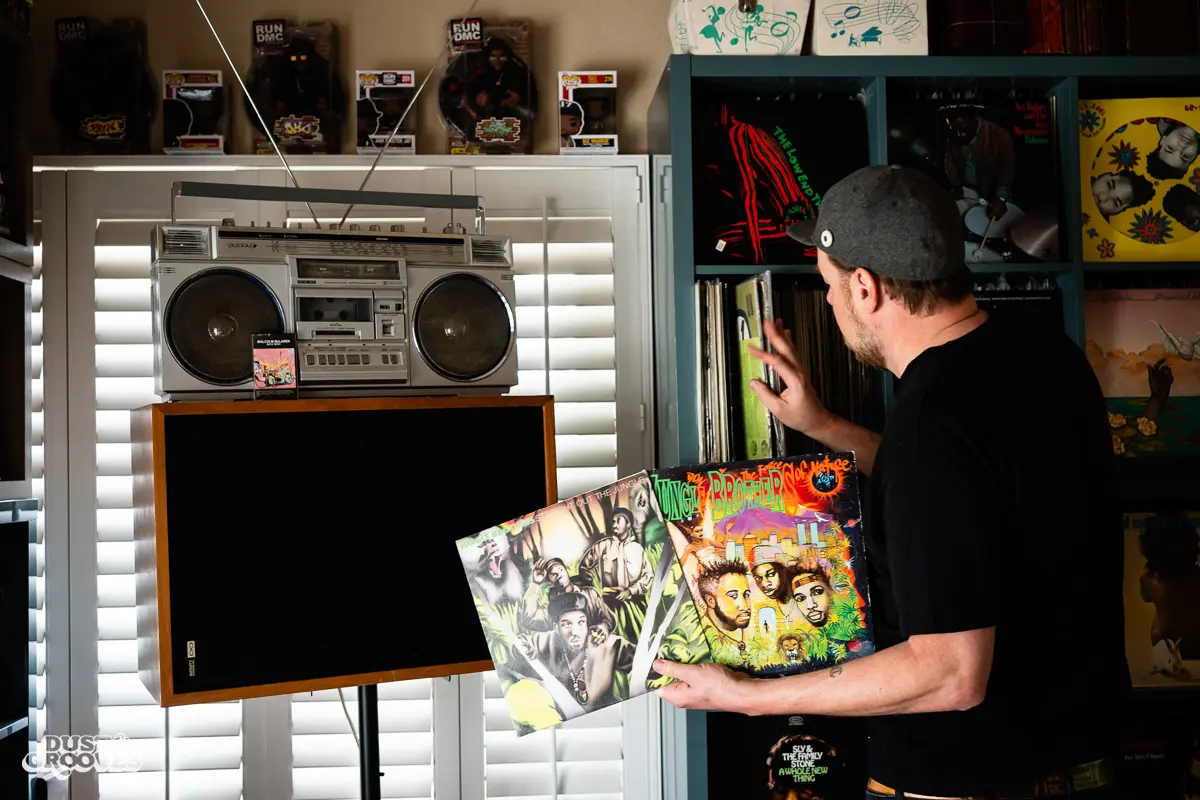
Jungle Brothers – Straight Out the Jungle & Done by the Forces of Nature
“Anyone who knows me knows how much of a Native Tongues nerd I am. This record laid the blueprint for what became, in my opinion, the greatest hip-hop collective. It stands the test of time, and the fact that it was basically created with a four-track recorder and set of turntables makes it all the more legendary.”
How did it feel when members of De La gave you feedback on the mix?
You make a mix like that for the sheer love and appreciation of the artist and the music. Then you find out that they heard it and that they really liked it. Then, they give you positive feedback, and eventually, you get an opportunity to meet them and share a stage with them. It was one of the most beautiful full-circle moments I’ve had in my music career.
You’ve DJ’d with Prince Paul multiple times. What was that like?
I’m still shocked that it happened, and that I’ve gotten to connect with him a few times. The fact that I talked to somebody I was so fixated on and enamored with was so important to me. He’s one of those guys who’s doing important shit to this day, and I still try to uplift and support his work any way I can. As far as meeting your heroes goes, it’s everything you could want.
The first time you heard De La was actually in Iceland at a youth club. Tell me about that.
This is almost 40 years ago now, but I do distinctly remember that the first listen was at a soccer club in Reykjavik, the capital of Iceland. On the second floor, there was a hangout place for kids with a little DJ setup. My cousin was the first to hip me to ’em.
They had a copy of 3 Feet High And Rising, and my cousin was like, “Dude, you gotta hear this.” We were so young and had grown up on Run DMC and Eric B. & Rakim, so we didn’t know anything that wasn’t relatively mainstream. Hearing it was eye-opening; I could only think how different it sounded from what I knew. It’s funny that I heard them in Iceland first because I didn’t hear the record or see it for sale in California for at least another six months.
How did Iceland receive pressings of the record before California?
In the States, Tommy Boy (De La’s label) was based in New York, and for some random reason, they also had distribution in Iceland (a very small market for hip-hop music back then). Back then, how music spread depended greatly on the distribution of physical formats; this meant that the location of a distribution center would indicate which areas listened to the label’s music.
When De La was first marketing the album, a really, really big portion of their fan base was “east of the East Coast.” It spread throughout Europe and Scandinavia well before reaching California or Asia. When you look at Native Tongues pressings, a lot of the Tribe Called Quest and De La stuff had better distribution in Europe than in the US, at least in the beginning.
De La Soul – Various UK import 12” singles. “I love the iconic imagery and different artwork on these, along with the alternate mixes. I first heard 3 Feet High & Rising at a youth club in Iceland. This was before it made any noise on the West Coast. The UK was always hip to De La Soul, and it showed in these releases. Often imitated, never duplicated.”
“There weren't a lot of super loud and bright colors in hip-hop at that time. Hip-hop had a subdued feel to it with a lot of darker colors. These cats were just like, ‘Dude, you know, we're having fun and the energy is really uplifting and positive.’”
De La has had a resurgence in the past few years, thanks to their music being added to streaming services after years of sampling issues. What are your thoughts on a new generation of people discovering De La?
First and foremost, it’s entirely warranted and so well deserved. They’re probably a top-three group coming from that era of hip-hop, and to be as relevant as they are today is crazy. Their influence is immeasurable. It’s a testament that the lasting power of doing your own thing and being adamant about your art speaks volumes.
They’re not trying to adhere to any particular formula; it’s all their own thing. It says a lot about why they’re still around and why people care about them. It’s not just that the music is amazing; it’s because they made something you want to praise and nurture, it’s them being themselves. We can all take notes from these guys when it comes to art.
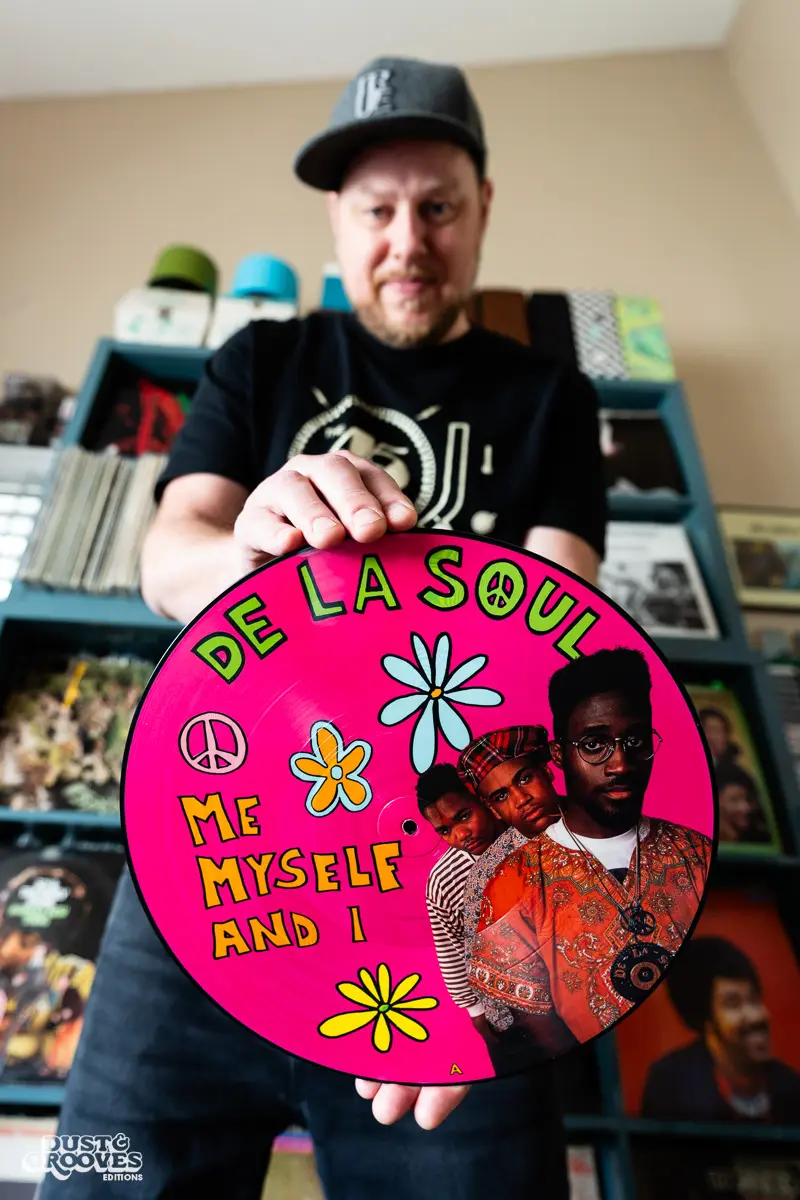
They built an entire world with the 3 Feet High And Rising album, and the cover art plays a significant role. What do you love about the art of the album’s singles, like “Me Myself And I” and “Say No Go”?
They’re so colorful, they pop, and it’s kind of leaning on pop art, but it’s still got this hip-hop feel to it–a straightforward kind of hip-hop feel to it. You look, and it’s kind of clear and simple, but it shouts at you. That’s the thing: there weren’t a lot of super loud and bright colors in hip-hop at that time. Hip-hop had a mostly subdued feel to it with a lot of flat colors. These cats were just like, “You know, we’re having fun and the energy is really uplifting and positive.” So, the look and feel of the actual visuals, the colors, and the design have to emulate that.I love that people are still very drawn to that aesthetic, and it’s constantly being reused in so many ways. People love anything that they put their logo on. There’s a reason why they drop merch all the time, because people love that shit. I get it, though; I was a nerdy kid, and the De La guys were like rap nerds to me. I resonated so much with that era and will always return to the Native Tongues era.
"All of the stuff they created had an aesthetic. It’s all being used, mimicked, and flipped."
"Often imitated, never duplicated."
You’re a big fan of the Jungle Brothers, another Native Tongues heavy hitter. What can you tell me about their influence on you?
The Jungle Brothers were the OGs in the whole Native Tongues scene; those guys were the first to really dive into what expanded into this wider world of music that nobody was really touching at the time. They were just fearless. On those first couple of records, they weren’t following any rules. I think that’s what I loved about that initial movement: it was all very raw. It was so focused on letting particular samples be–they weren’t manipulating a ton of stuff.
They broke an immense amount of ground in the art of sampling old records. Sometimes they would have as many as a dozen samples in one song. Nobody was digging for what De La, Tribe, and The Jungle Brothers were digging for. It’s so important that they opened up this world to the listeners because it expands your mind as a fan of music and art.

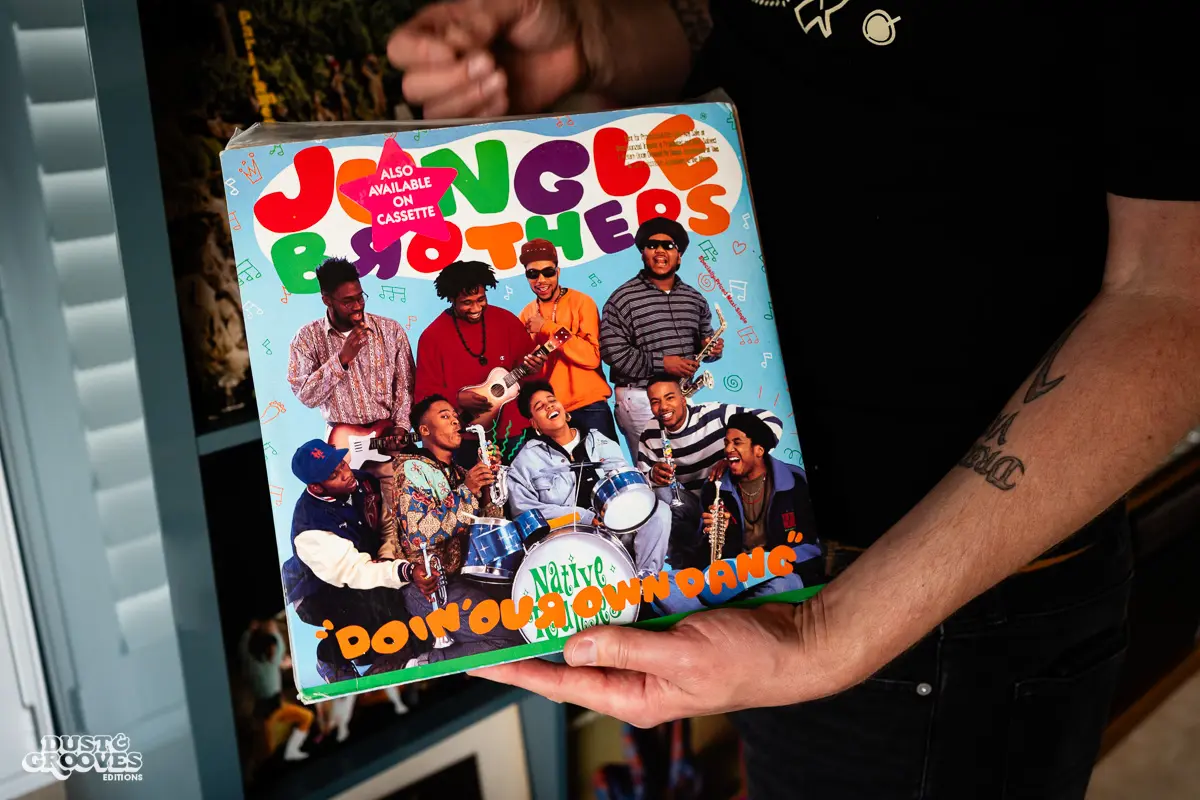
Jungle Brothers – Doin’ Our Own Dang
“I remember rocking this cassingle until it snapped. The cover’s iconography and style of dress were everything for me and my dance crew homies during that era. Especially that Commodores’ break and one of my favorite Posdnous lines, ‘Isn’t it cool when you cut your hand and the blood is red instead of sellout green.’ One of the best posse cuts of all time.”
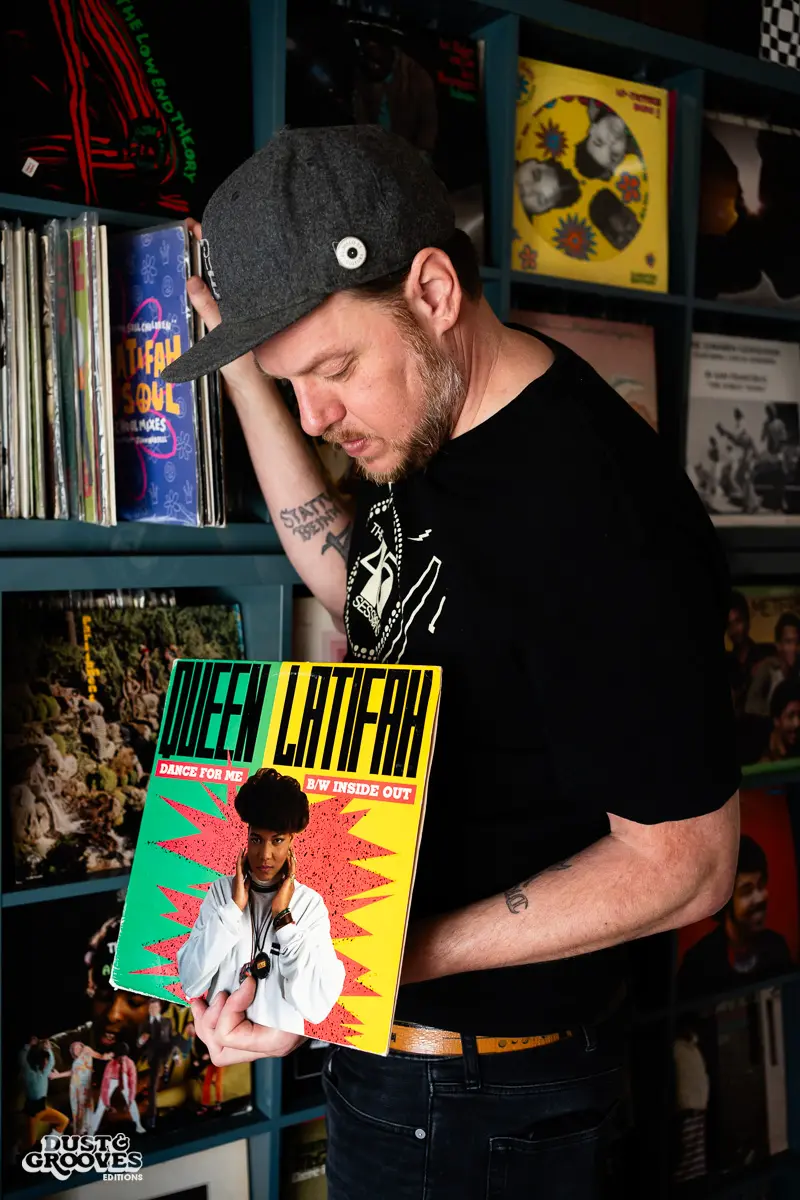
“Queen Latifah’s got the breath control and everything that you need as far as being a sick ass MC. She was just another dope MC in a sea of incredible creative people. And, she happened to be a woman. There weren't a ton of female MCs out at the time.”
Another name from the Native Tongues era you’re drawn to is Queen Latifah. Why was Latifah so important during that period?
Nobody looked at her like, “Oh, she’s a female MC. She’s a woman who raps.” Everyone was like, “Yo, this MC is equally on par with the dopest cats that are out right now.”
She’s got the breath control and everything that you need as far as being a sick-ass MC. She was just another dope MC in a sea of incredible creative people. And, she happened to be a woman. There weren’t a ton of female MCs out at the time, but none of her contemporaries were saying, “Oh, she’s dope for a girl or whatever.” She got props because she was the dopest, wrote her own shit, and had such an ill voice and pocket.
I used to listen to her tapes over and over. She’s just the queen, and her success was never about her being a female MC. That’s the end of the story. When you look at the most important aspects of an artist in terms of their unique entities, she has so many skills that stand out. The voice, the lyrics, the cadence, and all these things were just so dope. And she still is dope; there’s footage of her getting on stage and doing her thing, even to this day.
"Everyone was just like, ‘Dude, this MC is equally on par with the dopest cats that are out right now.’"
Further Adventures in Record Collecting
Dust & Grooves Vol. 2
Platurn and 150 other great collectors are featured in the book Dust & Grooves Vol 2: Further Adventures in Record Collecting.
Let’s move to some of your Icelandic records. Your connection to Icelandic music is best found on the Breaking The Ice mixtape (2019), which is all rare Icelandic music. Were you interested in Icelandic music growing up?
The specific sound you hear on Breaking The Ice was formulated a little bit later in my life. My parents always played Icelandic music in my house, but it was on the radio, and pretty straightforward, traditional stuff.
The Breaking The Ice sound is me diving a little deeper into aspects of that music. Most of the music from the years I focused on would be considered classic rock, but there were so many influences. The mix was all about finding groovy shit. I was looking for music with a pocket, a groove, dope baselines, super funky drumming, that kind of thing.
Funk music was not a thing in Iceland at that time. Something in the vein of Earth, Wind & Fire, Parliament–or whatever was considered American funk music–did not exist there. Iceland had rock music, but some of it had a funk edge to it, so that’s the stuff I was going after. It’s like “Dude, they’re making music without even knowing that somebody would be excavating and pillaging it later on for completely different purposes.”
How did you create the energy and atmosphere of the mixtape?
A lot of listening. I wanted the music that DJs would be interested in. When you’ve been doing this for as long as I have, your ears perk up and latch onto a certain kind of thing that you’re looking for. And it’s not the same thing every single time. A lot of it has to do with the driving percussive elements of the piece. That can be anything from how the drummer is playing, how the bass player is playing, or how the guitarist is playing–whichever rhythm instrument is the most prevalent is what attracts me.

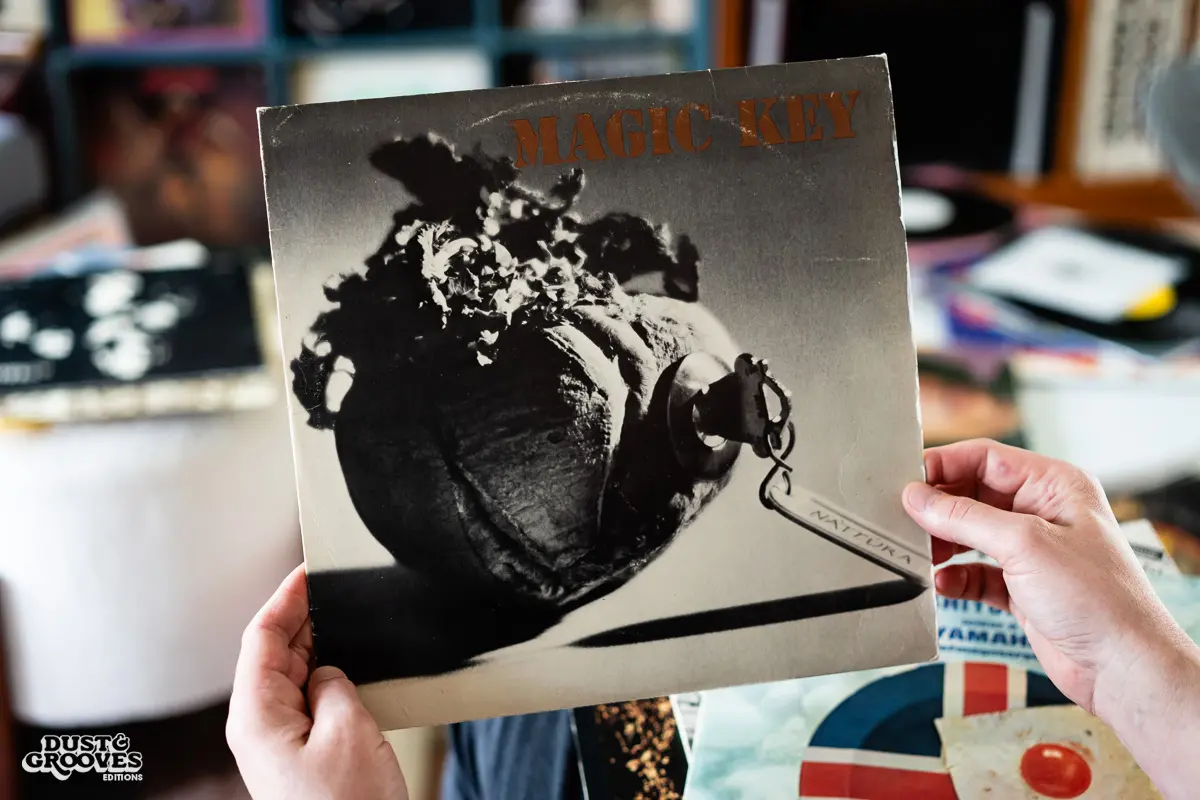
Náttúra – Magic Key
“A motherland favorite and a standout on ‘Breaking The Ice’, is an all groove-based Icelandic mix of this. Heavy psych featuring US-born, Icelandic music mainstay Shady Owens on vocals with killer drums and bass throughout. I’d put this in my top 10 for sure. Standout tracks are ‘Could It Be Found’ and ‘A Little Hymn for Love and Peace’.”
“Iceland and small islands in general have a very interesting place in music history. Island nations like Jamaica, Iceland, and Japan have had an insane amount of incredible music output over the years.”
You have a nice collection of early ’80s Icelandic rock compilations. Many of which have silly covers. Please tell me about these wild-looking Icelandic LPs.
I own these comps because of the kitschy aspects spread throughout the covers. There is great music on there, don’t get me wrong, but I enjoy the comical peek into that era of Icelandic music. To be perfectly frank, I didn’t give a shit about the traditional rock sound growing up.
Tell me about some of your favorite covers of these compilations.
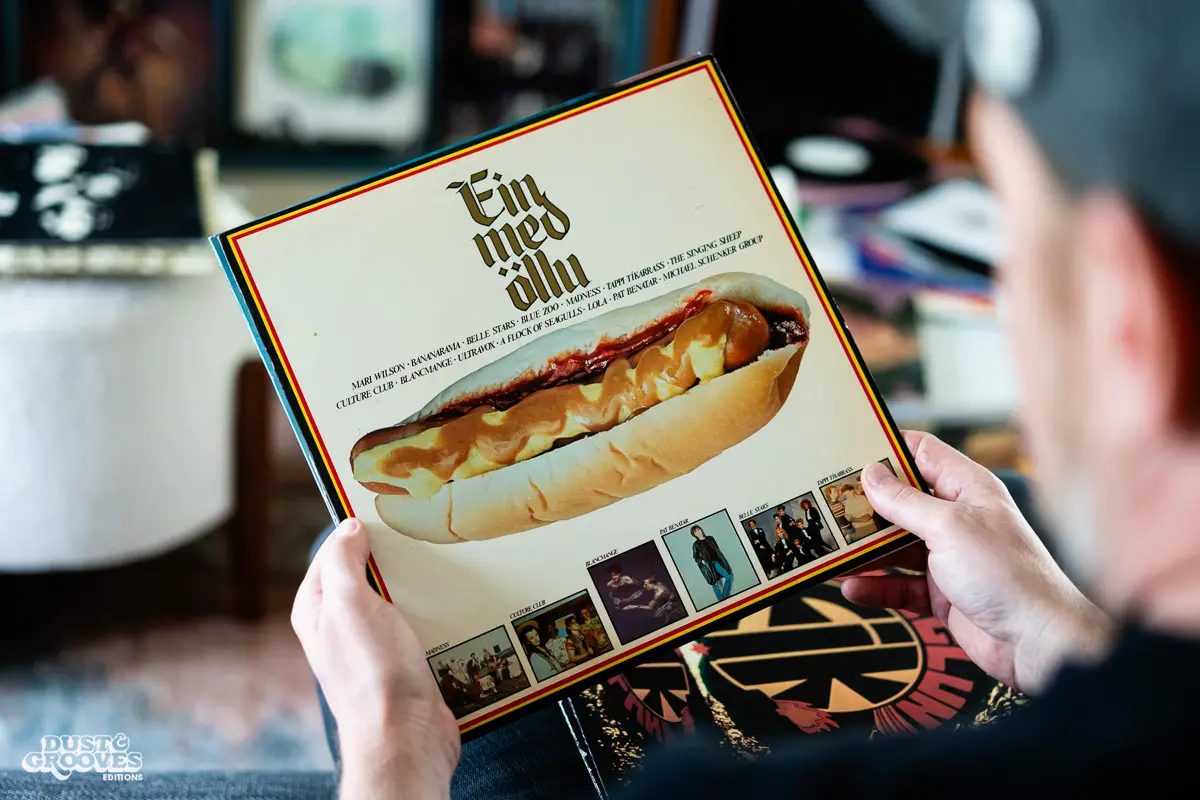
The cover for Ein Með Öllu (A 1983 Icelandic new wave comp) is just too funny not to share! One of the more famous culinary things you can experience in Iceland is the hot dog–it’s a huge thing back home. You can get hot dogs anywhere that sells food, and you’ll find them at every gas station. The cover is so hilarious, I almost want to frame it.
Another great cover is for the record Á Stuttbuxum, which literally means “In shorts.” I love the layout here and how he’s got a boom box and is rocking it.
There are a couple of really dope tracks on here. This is a “big hits of Iceland” compilation album, which was normal for countries to make in the ’80s. They’ll compile a handful of Icelandic songs that were either big hits or music the label is trying to push and promote. There are probably a hundred of these collections, and I own a handful of the covers I love.

Various – Ein Með Öllu
“One of the more famous culinary things you can experience in Iceland is the hot dogs–it’s a huge thing back home. The title of the record means ‘One with everything.’ You can literally go to Iceland today and get that exact same thing, that same bread, those same condiments that are on there. They’ve been making the same damn hot dog for probably 50 years.”
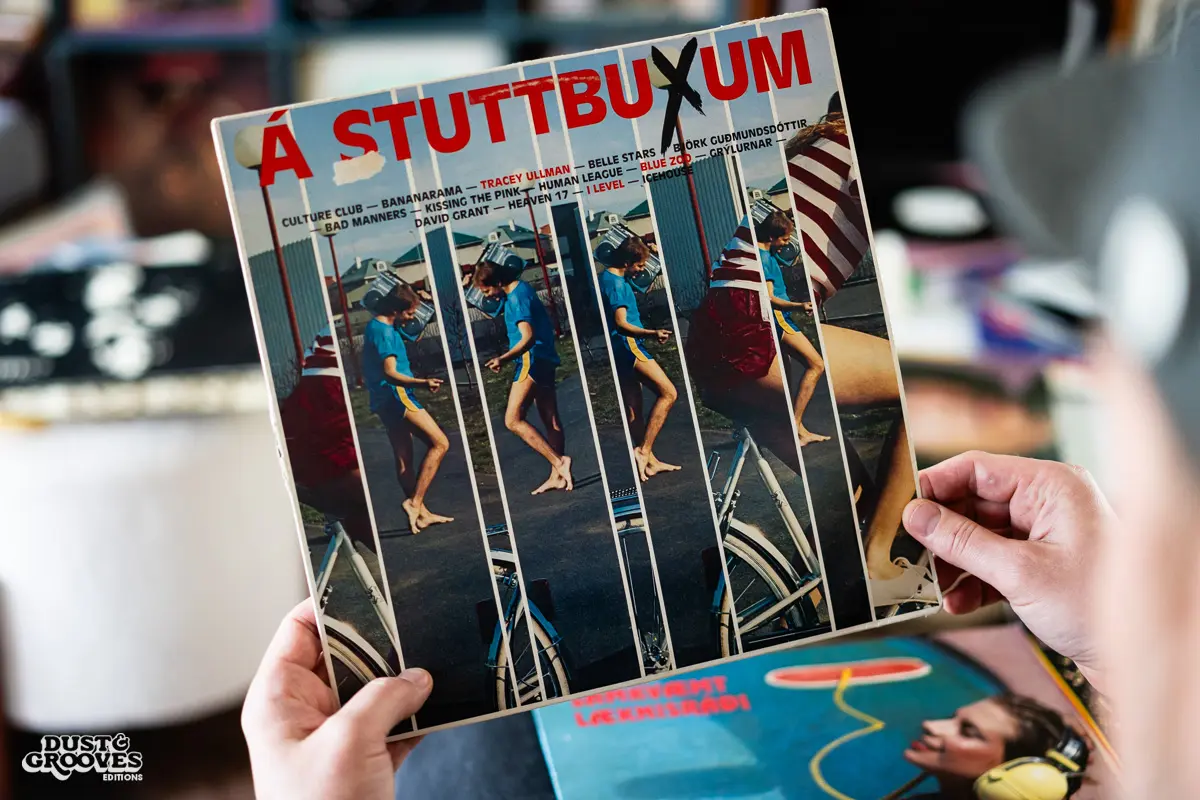
Various – Á Stuttbuxum
“The title literally means ‘In shorts.’ I love the layout here and how he’s got a boom box and is rocking it. I’m a big biking guy, so I love the feature of the bike on here. This is basically a “big hits of Iceland” compilation album, which was a pretty normal thing for countries to make in the ‘80s.”
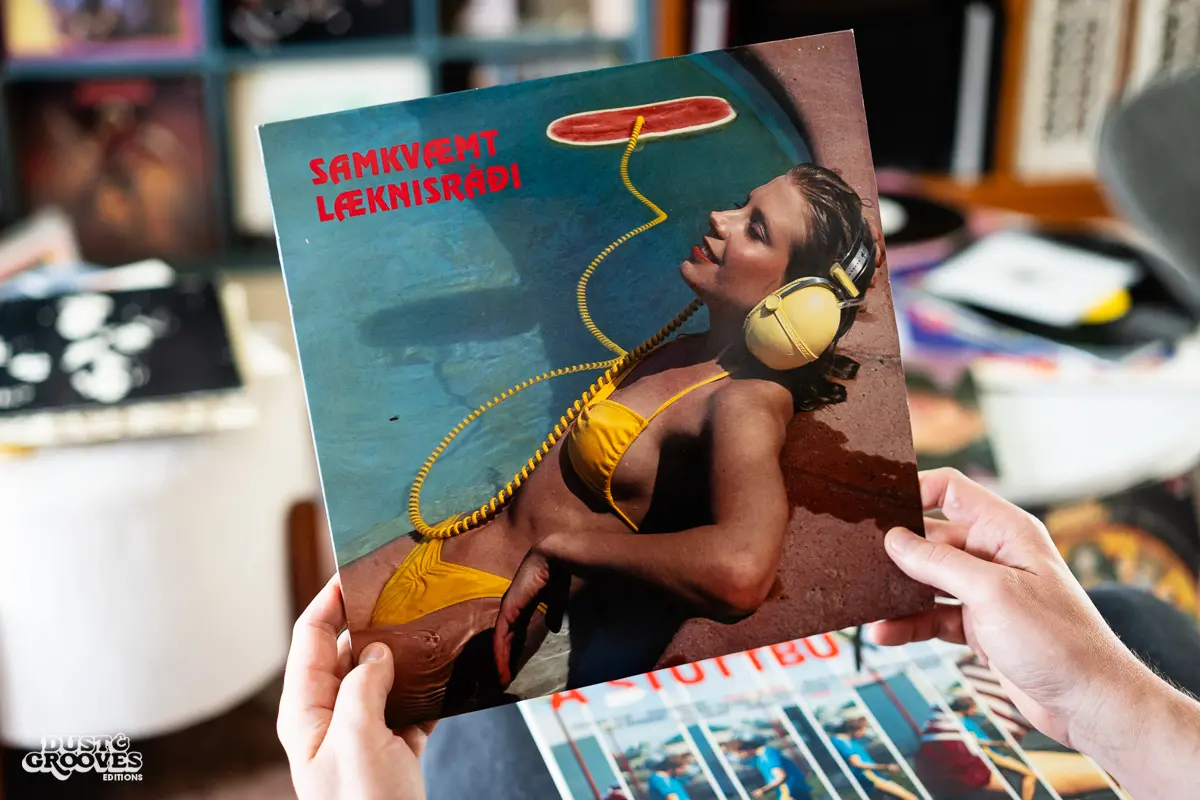
Hljómsveit Magnúsar Kjartanssonar – Samkvæmt Læknisráði
“This cover with a woman listening to music connected to a watermelon with headphones bigger than her ears is wild, too. This probably wasn’t taken in Iceland cause no one had a pool in their backyard like that. It must have been something from the States, but it is just ridiculous.”
So, you were drawn to these “big hits of Iceland” records for the covers and history, not the music?
For the most part, yes. What interests me is how an island country like Iceland, with such a small population, can garner compilations that pull in hundreds of artists spanning multiple decades.
Iceland and small islands in general have a very interesting place in music history. Island nations like Jamaica, Iceland, and Japan have an insane amount of incredible music output over the years. There’s a certain aspect of these cultures that is really adamant about nurturing art and music. People in Iceland are simply living their lives and doing their thing, and because the communities are so small and insular, that ultimately lends itself to incredible output. They say that in Iceland, something like one in eight people are in a band–it’s nuts.
Speaking of artists from tiny islands, tell me about Japanese musician Yoshiyuki Tao and his solo record.
Yoshiyuki worked for Yamaha and made the keyboard he plays on that record. He lived in Iceland while recording the album and created all these dreamy covers of Icelandic music. It was the only thing that he ever put out. It’s just him playing on the keyboard; it’s very spacey with lots of reverb.
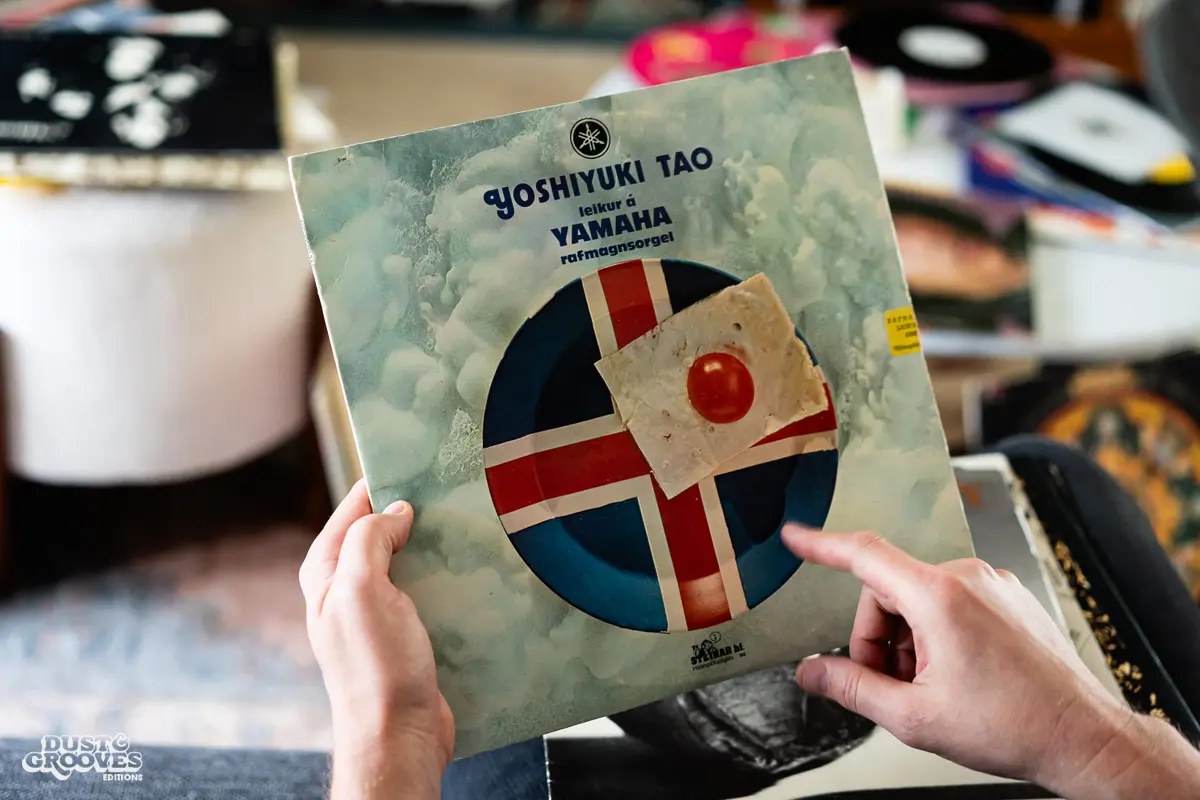
The cover is fantastic; it’s brilliant when you think about it. It’s an Icelandic plate sitting on top of snow, with an egg mimicking Japan’s flag—a clever way to incorporate his two influences.

Yoshiyuki Tao – Yoshiyuki Tao Leikur Á Yamaha Rafmagnsorgel (Yoshiyuki Tao plays the Yamaha Electric Organ)
“Not mega rare or expensive, but an odd and elusive record of Mr. Tao doing covers of popular songs and Icelandic traditionals played solely on the Yamaha Electone E5AR organ. Plenty of rhythm section stock throughout with loads of dreamy vibes. ‘The Shadow of Your Smile’ cover is definitely the winner and a track that also made it onto the ‘Breaking The Ice’ mix.”
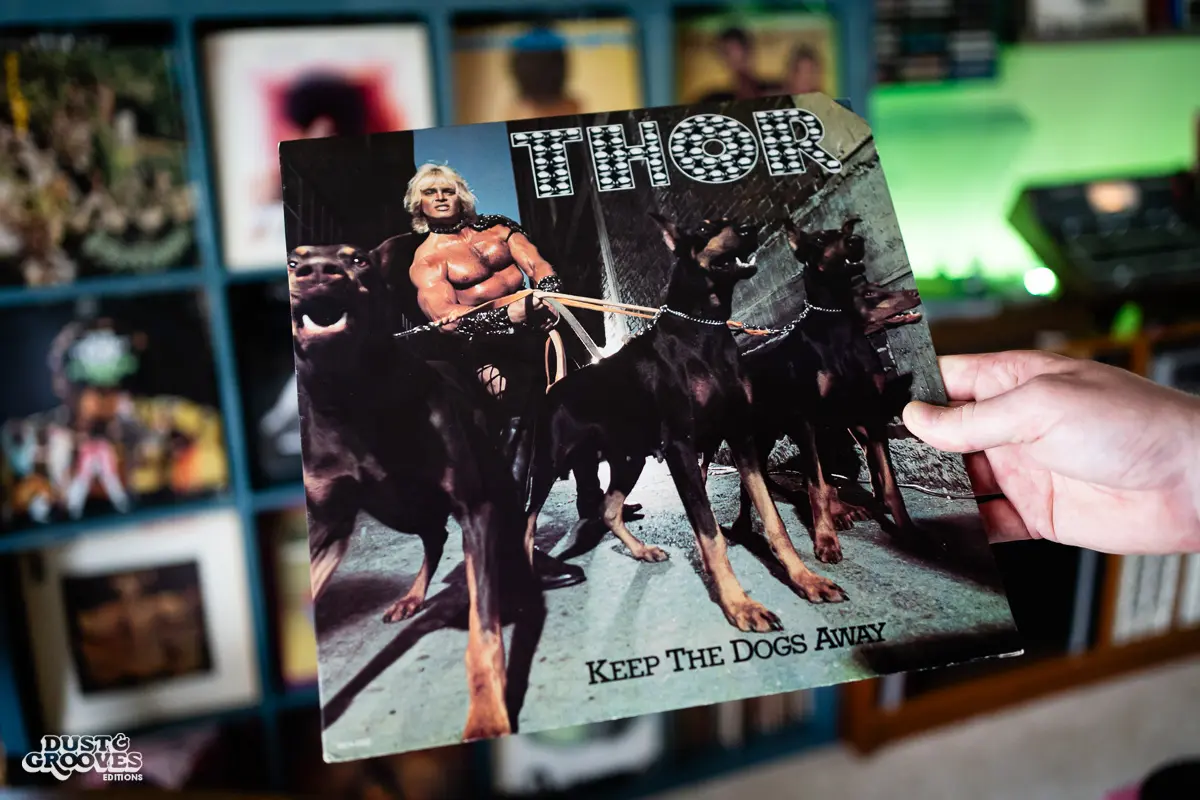
A wild cover you picked out that isn’t from Iceland is Thor’s “Keep The Dogs Away.” What is happening here??
Wow, Thor! Jesus, dude, he was a bodybuilder, musician, and actor from Vancouver. This cover is hilarious, and the poster insert is completely absurd. This is another kind of joke, one I wanted to share. The record is terrible, but man, the cover is great.

Thor – “Keep The Dogs Away”
“I have the poster hanging in my house, and it’s just completely absurd. It’s a full-on fold-out of him in some ridiculous outfit. It’s so silly, and the record is terrible, like, it’s really bad.”
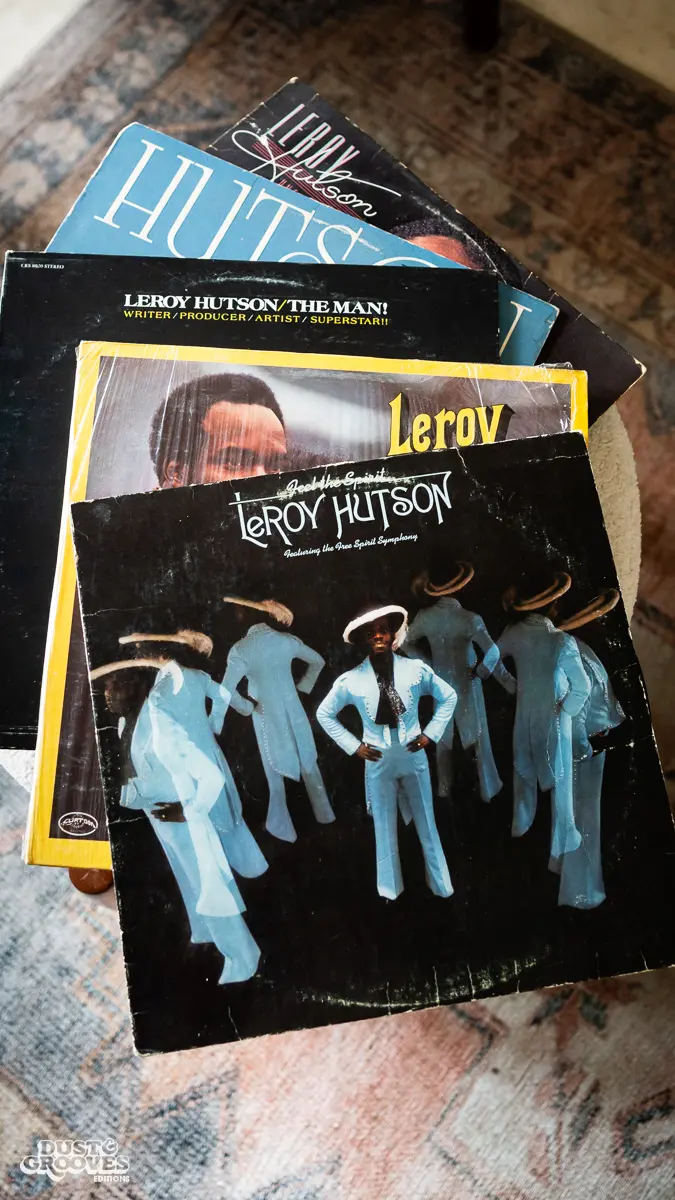
Tell me about Leory Hutson and your collection of his LPs.
He was someone I got into a bit later in my career. But I knew him from The Impressions. My dad was a big fan of Curtis and always played his albums in the house. I loved him and that sound of the Curtom label, so it was easy to gravitate toward when Leroy put a bunch of his stuff out on Curtom.
Leroy, his lyrics, and his voice are some of the best examples you could ever get out of soul music from that era. I just learned the other day that he was roommates with Donny Hathaway!
"He has one of the most unique voices and cadences in funk and soul music, and his penmanship is impeccable."
You have an incredible collection of James Brown and The J.B.’s 45s. What can you tell me about these?
I have a box that’s dedicated solely to James Brown picture covers. These are mostly pressings from Germany, the Netherlands, France, and Italy. Most James 45s you would get in the States were all styrene with no covers. Styrene is basically like the shitty, cheaper ingredient that creates 7-inches–it’s not real vinyl. It was used and invented to promote these singles on a much cheaper level. You can make a million of these things, and the cost per unit is way less than actually making a real vinyl version of it. The collecting community reveres the picture sleeve versions because they’re made out of actual wax versus styrene.
I have tons of James’ music and so much silly paraphernalia of his strewn about my house and in my studio. There’s no contesting his influence; he’ll always be the number one soul brother.

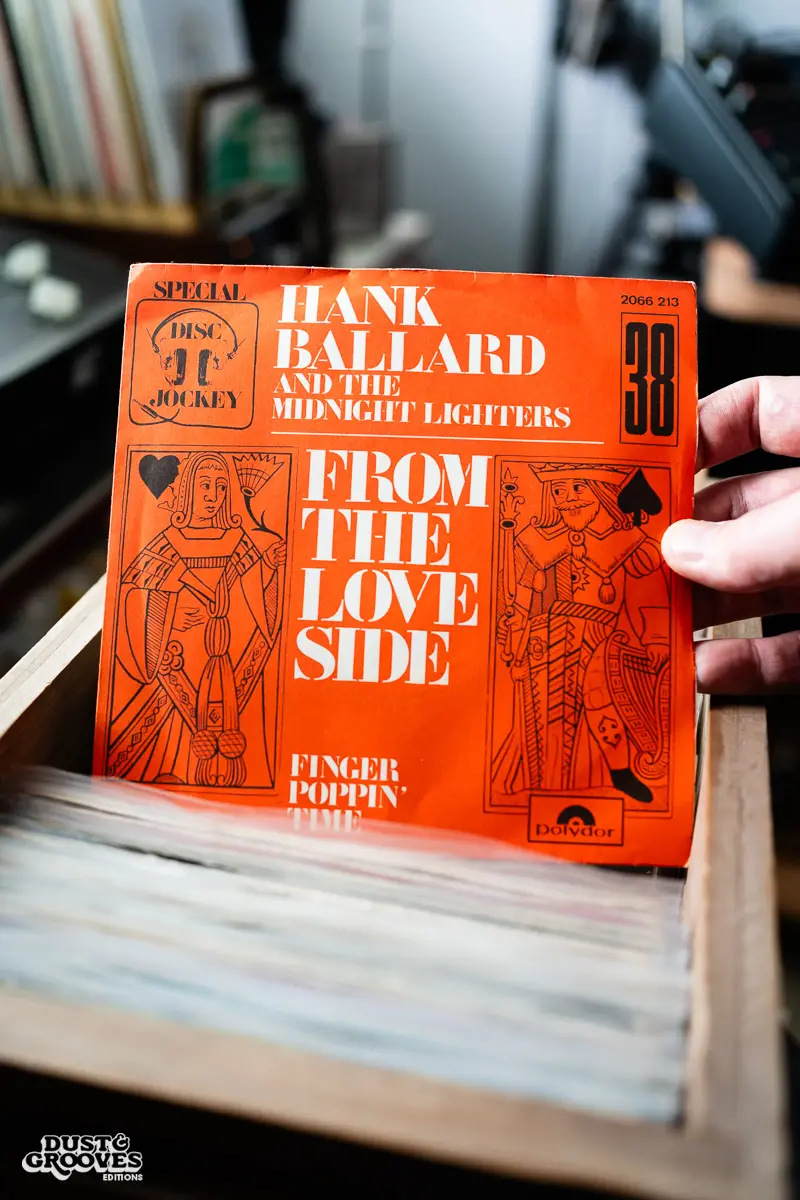
Hank Ballard – “From The Love Side”
“One of the best J.B.’s related joints and recorded so well. The British and European pressings are far superior on the 45 tip. The box this French press is in is filled with nothing but J.B.’s and extended family international picture covers. Collecting them has been an obsession of mine for years. I remember Joe Quixx playing this on the Wake Up Show as an interlude cut because it was so damn heavy.”
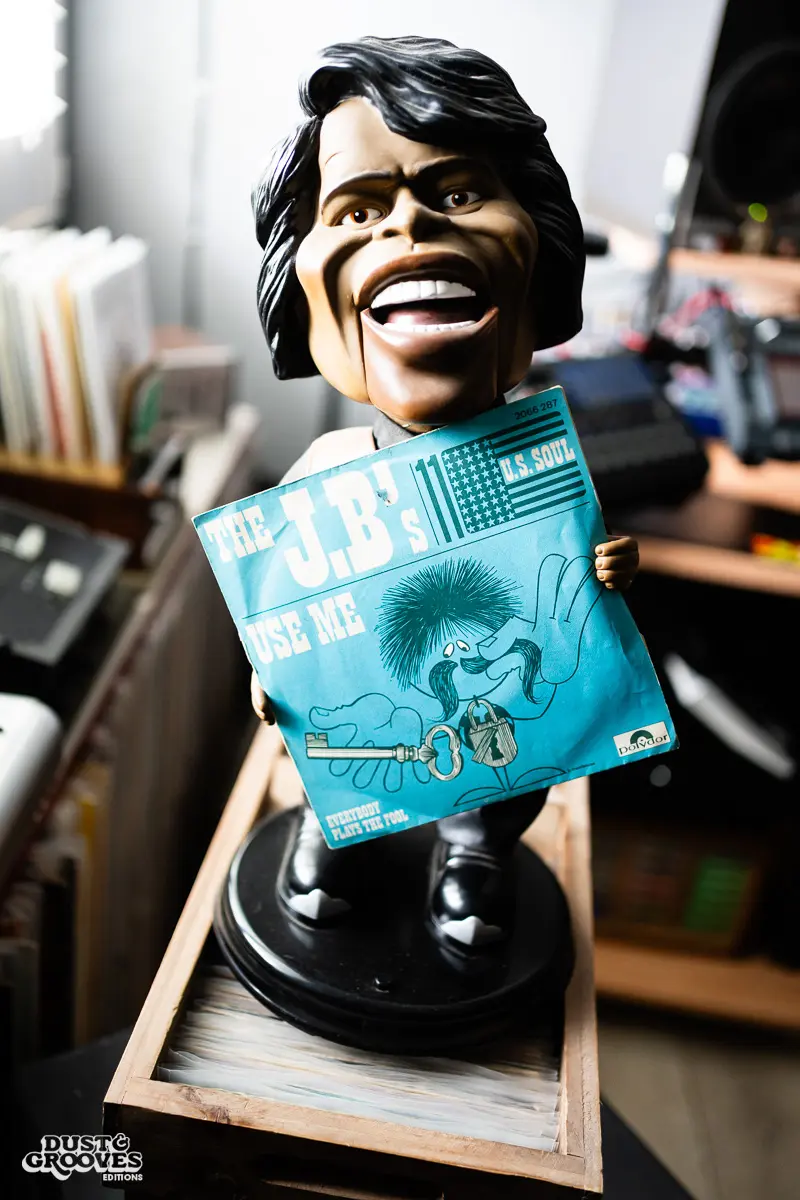
The J.B’s – “Use Me”
“When people talk about problematic artists, James is definitely near the top of the list, but if I were to make one exception to remove someone due to their work, it would be James. It’s undeniable, the track record speaks for itself, and his music will live forever. James is the king, man. Funk music, hip-hop, and modern music as a whole wouldn’t exist if it weren’t for James’ influence. Obviously, it’s not just him, but he brought so many musicians and vocalists in that would play a huge role.”
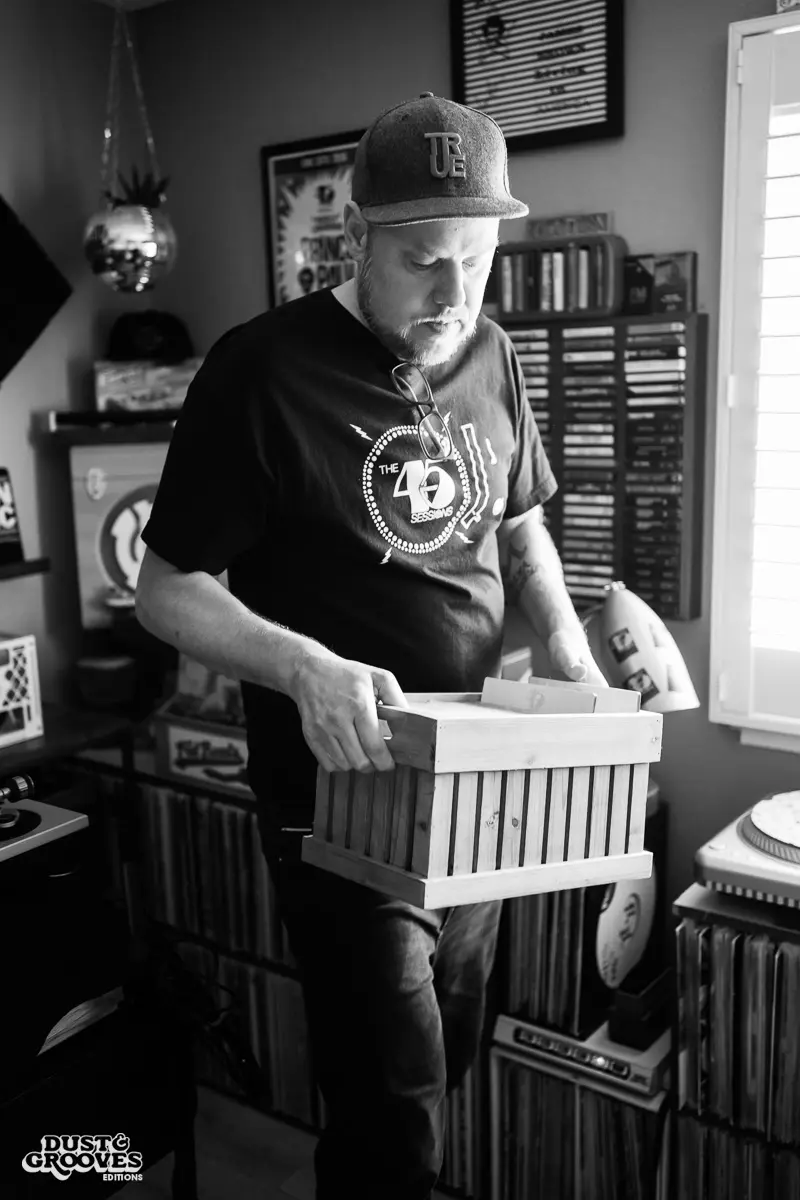
You’re clearly a big believer in the 7-inch; you even started a party solely devoted to spinning 45s. How did the 45 Sessions come to be, and where are they today?
The 45 Sessions were something we kind of did out of necessity. Eric Boss, DJ Enki, and I started this crew in 2010, and now we’ve been doing it for 15 years.
In 2010, there wasn’t a whole lot of interest in vinyl parties, definitely not 45s for sure, because this came a few years after the whole digital DJing thing started. Playing digital became the precedent in our industry, and I won’t talk shit, I play all formats, but it was a moment when we wanted a home to play 45s.
We started in Oakland and did it low-key for the first couple of years, and then it started blowing up. We never had any real desire or drive to make it any bigger than a place for us to get together, have a few drinks, and play these records. At one point, we did it every other week, and then it was monthly, and now our original plan has caught on, and we do a couple of big shows every year.
We’ve had DJs from all over the world come and play with us. Big names but also so many of the homies, and renowned collectors from all over the globe, come and share the stage with us. People come out for the simple reasons; all we’re doing is celebrating a format of music. That’s literally what it is. It has nothing to do with the music because we don’t tell our DJs what to play–we rarely ever have a theme for the Sessions. It’s just about the DJ and whatever the hell it is they want to play.
“The truth is that there are people who will always give a shit about vinyl and that will never change. So many people enter and leave vinyl collecting, but this format is here to stay, and that’s undeniable.”
What would you tell a young collector looking to start collecting 45s?
There are a lot of fun aspects about getting into 45s, but two stick out. The sound quality is the best you can get out of any kind of music because the grooves are well spread out, so the sound isn’t as compressed. The other advantage of 45s is that they’re easy to transport. They’re light, you can travel with them, and they’re easy to bring to sets.
With that in mind, it’s not for everyone. It is an extremely tedious aspect of collecting because 45s were essentially the MP3s of their day. 45s were never supposed to be a thing to collect; it was a cheap format invented to promote music on the radio. Eventually, they became collectible because many titles are sought after due to their scarcity.
What are your thoughts on the current state of vinyl collecting?
I’ve been doing this for so long and have watched trends appear and disappear constantly; this ebb and flow is constantly happening, and people will say, “Oh, it was the biggest year in sales for vinyl!” Then, it will take a dip, and no one will care.
The truth is that there are people who will always give a shit about vinyl, and that will never change. So many people enter and leave vinyl collecting, but this format is here to stay, and that’s undeniable.
The thing I would like to see less of is people falling for the hype and seeking out absurdly priced reissues, likely pressed on six different colorways that all sound like shit. It’s preying on the people who are into collecting (and ultimately flipping) rather than the music.
45s have a problem as well. If there’s one quote to take away, it’s that there’s too much music that gets put on 45s that shouldn’t be. I’m in this game, I’m in the middle of this scene, and there’s way too much being done surrounding 45s. It ruins a lot of aspects of what this is supposed to be about.
What are some of your go-to digging spots in the Bay?
I’ll give you a few, but not all of them–I can’t blow up my spots [laughs]. Groove Merchant in SF is legendary. Rookys is a spot where I’ve spent a lot of time. There’s a newer spot in the Mission called Discodelic, which I really love. And then Amoeba, of course, where I was a buyer for many years. It’s an absolute institution.

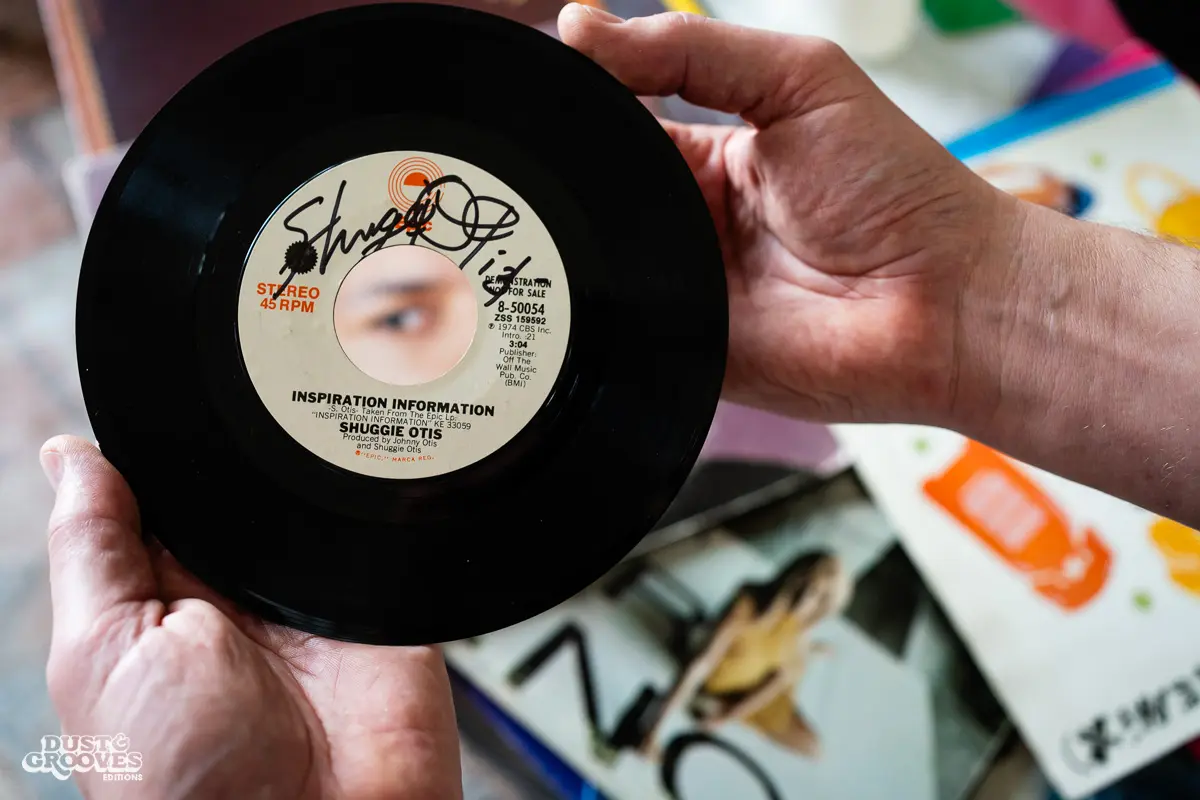
Shuggie Otis – “Inspiration Information”
“Some years back, I opened up for Shuggie Otis in San Francisco. It was one of the coolest gigs of my career. An older gentleman at that point, but his chops were still incredible. I brought him this promo after the show, and he was really touched. My wife even walked down the aisle to ‘Sweet Thang’. Shuggie’s a Bay Area legend, while his father, Johnny Otis, hails from where I live. I’ll cherish this 7-inch forever.”
What’s your comfort record, the one that gets you through the best and worst of times?
There’s no way I can pick just one. I’m going to give you three that I really enjoy from beginning to end, and that are big parts of my music personality over the years. Portishead – Dummy. Funkadelic – Maggot Brain. And De La Soul – De La Soul Is Dead.
Who would you like to see next on Dust & Grooves?
There’s a handful of folks, but shit, I would probably go directly to my crew and say Eric Boss. He’s a DJ, collector, vocalist, and musician. He’s part of the 45 Sessions and one of my best friends. He lives part-time in the US and the UK, and he’s a fantastic human, has insane records, and knows how to play them very, very well.
Where there are De La Soul 45s, there is DJ Platurn. He is the founder of the 45 Sessions, a member of the Oakland Faders, and has compiled and produced his mixtapes, Breaking the Ice and So This Is De La Heaven.
Further Adventures in Record Collecting
Dust & Grooves Vol. 2
Kevin Cole and 150 other great collectors are featured in the book Dust & Grooves Vol 2: Further Adventures in Record Collecting.
Become a member or make a donation
Support Dust & Grooves
Dear Dust & Groovers,
For over a decade, we’ve been dedicated to bringing you the stories, collections, and passion of vinyl record collectors from around the world. We’ve built a community that celebrates the art of record collecting and the love of music. We rely on the support of our readers and fellow music lovers like YOU!
If you enjoy our content and believe in our mission, please consider becoming a paid member or make a one time donation. Your support helps us continue to share these stories and preserve the culture we all cherish.
Thank you for being part of this incredible journey.
Groove on,
Eilon Paz and the Dust & Grooves team