
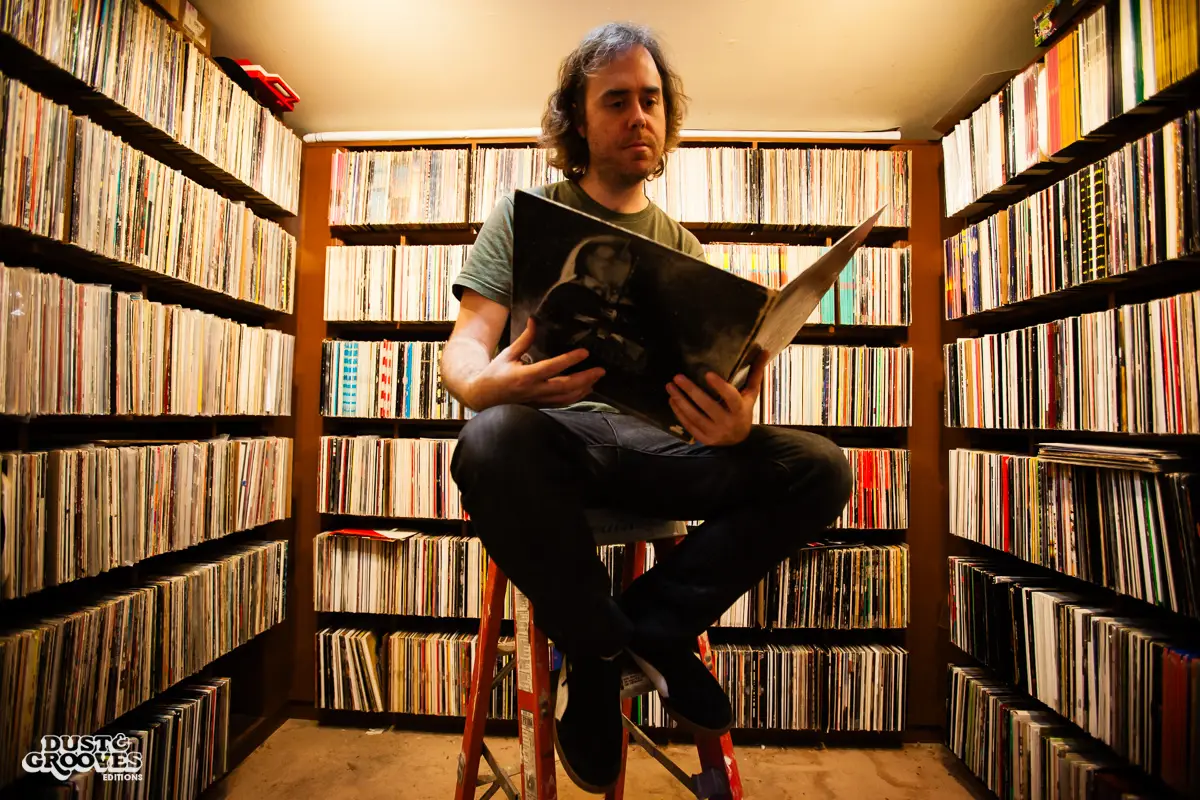
cut chemist
Ghosts in the Collection
BY Nate LeBlanc
Cut Chemist is a collector. From a young age, he was drawn to the pop songs that he heard on the radio. It wasn’t enough to have them waft through a room—he needed to possess them, to share them, and eventually, to manipulate them.
Cut Chemist is an artist. He draws, he paints, he has an art degree from UCLA. He is a gifted performer, but also a thoughtful, conscientious solo artist who painstakingly assembles music and mixes and doesn’t release them until they are perfect.
Cut Chemist is a storyteller. He speaks with his hands as one of the premier DJs in LA, a city full of record collectors and selectors. He also has stories, as you will read in this interview, about the records that he has acquired—tales from his extensive travels, souvenirs, and curios—and loves nothing more than a record with provenance from an artist he admires, its own kind of story.
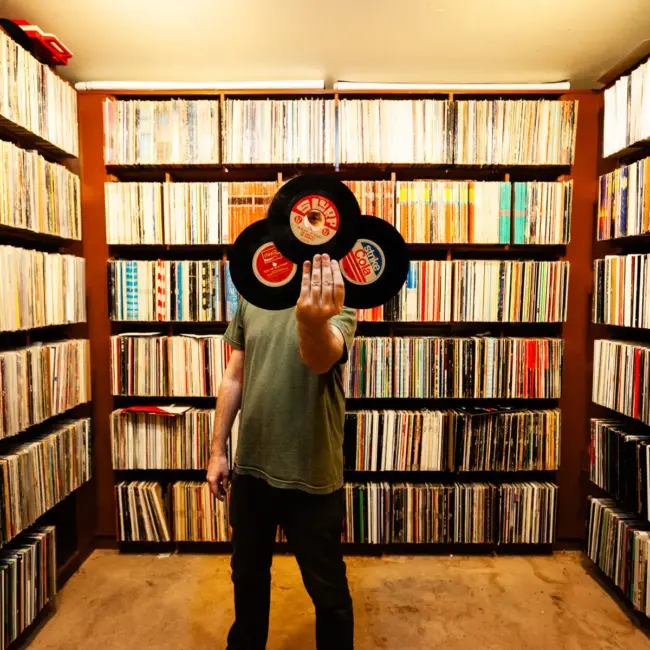
This interview is based on a photoshoot that Eilon conducted at Cut’s studio over a decade ago while collecting material for what would become the seminal photo book Dust & Grooves Vol. 1.
All of the traits that make Cut Chemist one of the premier DJs and collectors in the game will be on full display at Expert of None, a new series that Dust & Grooves is launching. Think of it as one man’s life story, told through music and recollection.
“There are ghosts in my collection. There are pieces of Rob One’s collection, pieces of Biz Markie’s collection, pieces of Red Alert, Bambaataa.”
—Cut Chemist
Before we dive into talking about records, can you tell us a little bit about yourself?
I am Cut Chemist, an artist/DJ/producer from LA and a founding member of Jurassic 5 and Ozomatli.
Every DJ starts out as a fan first. Star Wars seems like a huge influence on you. Your home studio, The Stable, has a life-size R2-D2 in a corner. What influence did that film and its soundtrack have on your musical life?
I was four years old when I saw Star Wars in the theater, first run in 1977, and I remember it vividly, like it was yesterday. Seeing the never-ending ship in the first scene after the opening crawl, I was wowed by that spectacle. But then there was something that I found interesting about that movie, which was that there were long sequences of no dialog. It was just music and image, particularly on Tatooine, the desert planet. It would just be this minimal, beautiful landscape of sand and sky with orchestral music and very little to no dialog, and that was very captivating to me. I would call that avant-garde by today’s movie-making standards. There was something very unique that I really responded to as a four-year-old. Growing up around music, having a baby grand piano in the living room, and my mom playing piano, I was already drawn to music, so it only made sense that I would respond to that musically.

John WIlliams & The London Symphony Orchestra – Star Wars
“There were long sequences of no dialog. It was just music and image, particularly on Tatooine the desert planet, it would just be this minimal, beautiful landscape of sand and sky with orchestral music and very little to no dialog, and that was very captivating to me.”
Have you ever publicly played with the music of John Williams? Have you remixed anything or used it in sets?
To continue reading this interview we humbly ask you to consider supporting Dust & Grooves by becoming a paying premium member.
Have you ever publicly played with the music of John Williams? Have you remixed anything or used it in sets?
Yeah, I did this very unique gig at the Walt Disney Concert Hall in 2007. The concept of the show was taking Russian Stalin-era classical music and mixing it with electronic music. So I did this thing where I mixed pieces of a Star Wars soundtrack with Igor Stravinsky’s Rite of Spring, because I think they’re very similar. I’ve never really heard anybody talk about it, but I feel like John Williams took direct inspiration. When you play the Jawa work music next to a section of Rite of Spring, it’s almost identical. The big orchestra swells, like in the space battles—also, there are certain sections that are really similar. So I did this mix, this “mash-up” of the two. Igor Stravinsky is, you know, adjacent to Stalin-era Russian classical music. I was mixing other things, like Prokofiev and Rachmaninoff and stuff like that. But that was the big aha moment: I don’t know if anybody else is thinking about this. Let me school people on my opinion on the inspiration of John Williams.
Though you have a world-class record collection with many original pressings, you also have an affinity for compilations, especially the Super Disco Brakes series. Why are these records important to you, and do you remember where you came across them?
Yeah, I actually bought them at Music Factory in New York from Stanley Platzer in the late ‘80s. Stanley was one of the big-deal beat brokers, so to speak. His store was one of the main outlets supplying DJs and producers with records to sample. I regard those as some of the first compilations. They predate Ultimate Breaks & Beats and Octopus Breaks, I’m fairly sure. Those compilations are a big deal in the lineage of sample-based music, absolutely.

Various – Super Disco Brake’s Volume 2 & 3
“I bought them at Music Factory in New York from Stanley Platzer in the late ‘80s. Stanley was one of the big deal beat brokers. His store was one of the main outlets to supply DJs and producers with records to sample. Those compilations are a big deal in the lineage of sample-based music”
It seems like that would have been before there was any kind of taboo on using records that were meant for sampling. You’ve been a DJ and producer for a long time. Do you always try to sample off of originals, or will you use a compilation if it’s handy? Do you have a philosophy on how you approach building tracks these days?
Well, back in the day, I cut my teeth on compilations. We actually have an episode of this Expert of None series that’s dedicated to compilations, because I feel like no matter how cool you are, your taste has been cultivated from comps to some degree.
But nowadays, to keep my music unique from the next guy, I want to pull from material that other people won’t have or think of. So I tend to stay away from comps to make unique compositions, but I still buy and listen to comps to learn about music and cultivate my taste further in different directions.
Records are getting really expensive, so if there’s a Numero comp of something I don’t want to invest in monetarily, but I still like the music, then I’ll buy a quality reissue of it. You know, it’s tough to go out and buy or listen to all the Zambian records that you might like, so a compilation seems to be the most affordable option, money- and time-wise, to figure out what it is that speaks to you, and then you can discern what you want to invest in and look for from there. So yeah, compilations still play a role in my collection.
Collecting records is one thing, but looking for acetates and other unfinished formats is a whole other level. Do you have any acetates that you are particularly fond of?
Probably Disco Boogie by Joseph Clark. It’s a mix, a good one too, and it was never released on vinyl. However, there were several acetates cut off it, so it’s not rare as far as acetates go. I originally found one on a digging trip with DJ Shadow during his Goodwill tour in Baltimore. We were at a shop, he found it, and we were listening to it. I was like, ‘wow, there’s some disco breaks on here that neither of us recognize’ at the time. We later discovered that they were “Pipeline” by Bruce Johnston and “Flip” by Jesse Green and stuff that just wasn’t on my radar yet.
I love mixed records. I love disco mix records, and that is one of my favorite ones to this day. It’s very well mixed. Those mixes are very inspirational. So that’s kind of the big one for me, even though it’s, like I said, not the rarest one. But I think it’s probably one of the better mixed ones.

Joseph Clark – Disco Boogie acetate
“I love mixed records. I love disco mix records, and that is one of my favorite ones to this day, it’s very well mixed. Those mixes are very inspirational. So that’s kind of the big one for me, even though it’s, like I said, it’s not the rarest one, but I think it’s probably one of the better mixed ones.”
“Compilations still play a role in my collection.”
As you have made your way through your career, you’ve had a chance to meet many of your DJ heroes. Given the opportunity, you like to have them sign records they were involved with. Do you have a particular record or two that have impressive autographs that you can share with us?
I have the Arawak “Apache” 12-inch bootleg, and also the Guava variant of that same bootleg. Jazzy Jay, Afrika Bambaataa, and Kool Herc did a show dedicated to a friend of mine named DJ Dusk after he passed away, and all three of those guys were DJing at this event.
And I was like, wow, that’s like the big three right there. I mean, Jazzy Jay is a massive, massive influence on me. And I thought, well, what better thing to bring for them to sign?
It seems like a record’s provenance is really important to you, that it adds a level of historicity to these objects and makes them more meaningful to you.
It does. There are ghosts in my collection. There are pieces of Rob One’s collection, pieces of Biz Markie’s collection, pieces of Red Alert’s collection, Bambaataa, you know. So it’s interesting to just kind of tell yourself this story with these records in your collection that are right up against records that you bought.
That’s beautiful. What was it like to meet Kool Herc?
I mean, I couldn’t believe it. I had to pinch myself. You know, he is ground zero for everything. I don’t know what more to say than that. Just being that close to how all this started was a huge honor.ly, is a way to celebrate his fight for artistic freedom.

Arawak All Stars – “Bongo Rock” b/w “Apache”
The Apache Band – “Bongo Rock” b/w “Apache”
“Jazzy Jay, Afrika Bambaataa, and Kool Herc did a show dedicated to a friend of mine named DJ Dusk after he passed away, and all three of those guys were DJing at this event.
And I was like, wow, that’s like the big three right there. I mean, Jazzy Jay is a massive, massive influence on me. And I thought, well, what better thing to bring for them to sign?”
Do you remember anything about what he played?
I don’t. That night was a blur. I mean, there was so much going on. It was the celebration of Dusk’s life, and he was a good friend. So the emotions were, you know, highs and lows. But I do remember him dropping some of the classics, James Brown, that kind of thing. And there were a few head turns, you know, like, “oh okay, that’s an interesting choice there.” I can’t remember exactly what it was, but he seemed to go all-city in the genre world.
We’ve talked a little bit about compilations, bootlegs, and disco acetates. What are some other types of mixes we might find flipping through your collection?
I love LA radio mix records. So take the Joseph Clark idea in the disco mix genre… Dr. Dre, Lonzo Williams, DJ Yella, Unknown DJ, Antron all did mixed records as well. 1983 and 1984 is the time of one-sided mixed records. They were basically like mega-mixes by these DJs.
For West Coast hip-hop, those are very important records, and they are important influences on me. I could write a book on Dre and listening to him doing Traffic Jam mixes on KDAY every afternoon at five o’clock, then graduating to putting out records with World Class Wreckin’ Cru and NWA. Watching his Coachella performance, I had tears in my eyes, because it was like watching my childhood and teen years and adulthood all mixed up in one stage performance. These records were absolutely seminal for me.

Dr Dre, Lonzo, Yella, Unknown DJ, Antron – Assorted 83-84 one sided LA megamix records
“For West Coast hip-hop, those are very important records, and they are important influences on me. I could write a book on Dre and listening to him doing Traffic Jam mixes on KDAY every afternoon at five o’clock, then graduating to putting out records with World Class Wreckin’ Cru and NWA.”
For people who only know of Dr. Dre as a headphone entrepreneur, can you talk a little bit about him as a DJ and what he was doing at this time that made him stand out?
Yeah. I mean, for one, he was an understudy of Egyptian Lover. Uncle Jamm’s Army and Wreckin’ Cru were kind of like two sides of the same coin. They were doing these very detailed mega-mixes, whether it was live on multiple turntables or whether they were studio-created. The musicality that went into these mixes, the things that they would blend, were incredible.
The first time I heard Parliament was on a Traffic Jam mix by Dre. He played the beginning of “Mothership Connection,” the whole speech. And he would drop some more obscure stuff, like Section 25 “Looking From a Hilltop,” which is UK, Factory Records type stuff. I remember he played “It’s In The Mix” by Slim, which is kind of a left-field go-go record, as well as the hits of the day. So he was spreading out musically in these mixes. There was just something about his ear. He used to blend things that were in key or do these unique question-and-answer segments. And he played a lot of Prince. Yeah, lots of Prince alongside “Smurf Dance” by Spyder D, Malcolm McLaren “Buffalo Gals,” stuff like that.
Oh, and another huge one, probably my favorite one of all, is somebody that I didn’t mention: The Glove. Chris “The Glove” Taylor did one called Scratch Dance, and it’s on a label called Carbon Copy. That one is bananas because it barely touches on hip-hop; it’s closer to new wave. He’ll play “Raid” by Lakeside, then something like “State Farm” by Yaz, and then into “Buffalo Gals,” which is like the same beat. These dudes were pretty much doing production work with these mixes, to the point where you couldn’t tell what was starting and what was ending—it was seamlessly blending together.
You are a trained visual artist, and cover art is super important to you. Do you have a record in the collection where the cover is particularly important to you?
I actually have two copies of Rammellzee vs. K-Rob Beat Bop with the Basquiat cover. That particular copy belonged to Steinski, so that one holds a special place in my heart. He had tempo-marked it, which, at the time, I was like, ‘oh man, there are some markings on it,’ so I bought another one that was completely clean. And then I’m like, ‘no, of course, I would want the one that has problems and the markings on it.’ The record’s fine, and the jacket’s fine, and it even has his little catalog sticker, how he used to file his records. So that one’s gonna probably stay with me, whereas the other one I can sell.

Rammellzee vs K-Rob – Beat Bop
“I actually have two copies of Rammellzee vs. K-Rob Beat Bop with the Basquiat cover. That particular copy belonged to Steinski, so that one holds a special place in my heart.”
Further Adventures in Record Collecting
Dust & Grooves Vol. 2
Cut Chemist and 300 other great collectors are featured in the book boxset of Dust & Grooves Vol 1 & 2.
Wow, amazing provenance again. What about that record speaks to you musically?
I mean, it’s psychedelic rap. I don’t know a better example than that. What I can tell you about the importance of that record for me is that it’s the convergence of fine art and music and records. Being a fine artist who graduated from UCLA’s art program, anything that marries two things that I’m passionate about—records and fine art—I’m all in, you know. I’m invested 100%, and I think that that record is the absolute peak of that.
Another amazing cover in your collection is this MC Breeze record, “Your Cranium’s Cracked.” What makes this one special?
Philly is a very special place. The early hip-hop there was a little bit outsider, like pop art records. There was a certain psychedelic approach to the music, thanks to Marley Marl. Marley did a lot of their production, specifically “Shout” by Craig G is a good example. 1985 was a great year for experimentation, and it was a really interesting transitional year where things weren’t really quite figured out yet. “Marley Scratch” is from ’85, which is probably the first of this kind of experimental hip-hop. That leads to the type of rap record that this MC Breeze one is.
It’s kind of silly to me in a lot of ways. There’s comedy, there’s street, it’s tough, but it also doesn’t take itself too seriously, kind of like Schoolly D. All his records are great, but I really like the cover on that one. Buying records back in the day, when you’d see a cover that had graffiti on it or some kind of drawing that evoked hip-hop, you would just pick it up.

MC Breeze – Your Cranium’s Cracked
“It’s kind of silly to me in a lot of ways. There’s comedy, there’s street, it’s tough, but it also doesn’t take itself too seriously, kind of like Schoolly D.“
“I never knew Shadow did a Lesson 4 when I did mine.”
You are a historian of the “park jam” era of hip-hop. Is there a record that you would recommend for modern listeners to help understand what records were being played at these parties in hip-hop’s formative years?
Yeah, probably Afrika Bambaataa’s Death Mix, which is an important record for me. As I was starting to get tapes of live hip-hop parties and park jams and stuff, I became fascinated with that era. And this is that era on a piece of vinyl. It doesn’t pre-date Live Convention, but I feel like this was more of a DJ record, because it was a DJ set with an MC shouting things out, rather than rapping, whereas Convention was more rap-forward, yeah. So, yeah, it’s a big deal for the narrative of hip-hop records being pressed up.

Afrika Bambaataa – Death Mix
“As I was starting to get tapes of live hip-hop parties and park jams and stuff, I became fascinated with that era. And this is that era on a piece of vinyl.
You and DJ Shadow were both influenced to make DJ records by Double Dee & Steinski’s Lesson 1, 2 & 3, and unbeknownst to each other, both recorded and pressed homage tracks—your respective takes on making your own version of Lesson 4. It’s a great story and proof that you guys were meant to meet someday. I see you have the two singles side by side and this crazy flyer that says “stop the rape of hip-hop.” What’s that all about?
So, I never knew Shadow did a Lesson 4 when I did mine, which is maybe two years after his came out. His was promo-only because they couldn’t clear the samples on Hollywood Basic. It was a B-side to his Lifer’s Group remix, and so it was quite rare, even then. I was even down with the Impact record pool here in LA, and it still didn’t come across my desk.
So I bought that off Joe Quixx in the Bay Area, when he was selling a bunch of records. I remember going with Lyrics Born to check out what he had. It had the insert with the flyer done by 8th Wonder, who was Josh’s buddy, Stan, who did graffiti for a lot of his releases. Since I dabbled in graffiti and art, I really liked having that insert. He went in on that one. And I finally got to hear Lesson 4 and see how Stein and Douglas had influenced his journey and how it started.

Shadow – Lesson 4 B-side to Lifer’s Group “Real Deal”
Cut Chemist – Lesson 4 B-side to Jurassic 5 “Unified Rebelution”
“I never knew Shadow did a Lesson 4 when I did mine”
“You start sharing these things and going, 'who’s down with this? Let’s form a crew!'”
Your collaborative mixes with DJ Shadow, especially Brainfreeze and Product Placement, were really important to me and I still listen to them regularly. What can you tell us about the 45s that set the tone for those sets?
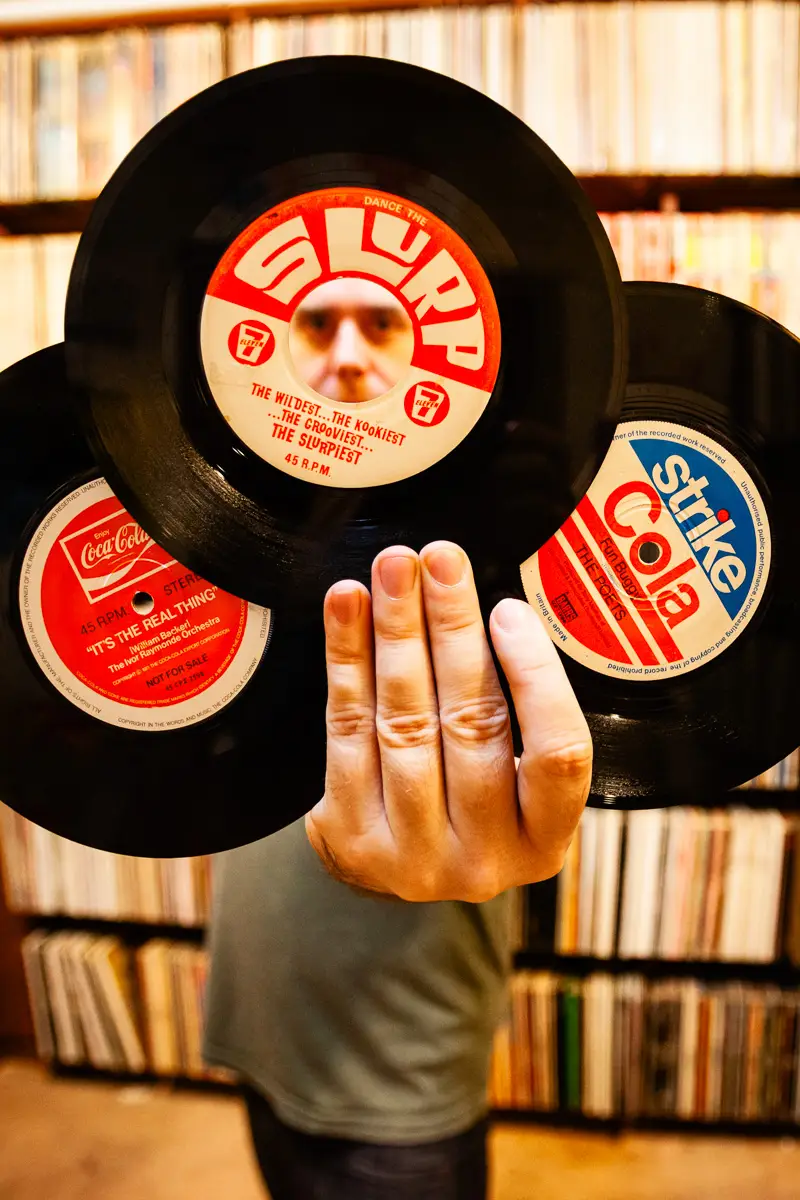
We found these Product 45s, right? Like 45s that are funky, that are promoting a product. So there was something very fun and interesting about that. It’s such a niche thing to buy. Full disclosure, I didn’t know about the “Slurp” record. I learned about it from Z-Trip, who learned about it from somebody on the Beastie Boys tour who told him, “Hey man, there’s this crazy record selling Slurpees, and it has a drum break.” And immediately I was like, oh, I’m interested. I gotta find this, it sounds wacky. What’s a drum break doing on a Slurpee record? And then I think Shadow ended up finding it. And then I said, “Let’s do a mix with it.”
Then there are two from Product Placement. The Coca-Cola record—that’s the UK version. I have another US version that’s not funky; it’s just, [sings] “It’s the real thing.” This one is an instrumental. So this doesn’t have the vocals, it’s just a horn arrangement. Oh, and with a banging drum break.
The Strike record is, I think, Scottish maybe. DJ Format may have told me about that one. He’s the king of breaks, really. When it comes to European and English records, his knowledge is insane. I don’t know what was in the water there, why they felt like they needed to have funky breaks to push their product. But they’re right on, because I would have bought a six-pack of Strike Cola right on the spot.

Double Dee & Steinski – Lesson 1, 2 & 3 Jurassic 5- “Improvise” b/w “Lesson 6: The Lecture UK 12” “Lesson Six is obviously my second homage to the great Double Dee and Steinski”

The Brainfreeze & Product Placement 45’s:
7 Eleven – “Dance The Slurp b/w The Strange Things”
The New Seekers / The Ivor Ryamonde Orchestra – “Buy The World A Coke” b/w “It’s The Real Thing”
The Poets – “Fun Buggy b/w Heyla Hola”
“One of the greatest photos of me ever taken, thanks to Eilon. 45s that are funky, that are promoting a product. So there was something very fun and interesting about that. It’s such a niche thing to buy.”
You were a dedicated hip-hop head from early on. But do you have a punk rock side? Do you have some punk rock records? Does any of your music have punk rock energy?
I have this Sound of NY, Punk 1980s. It’s another mix record, and that one’s cool because it uses “Rock Lobster” by the B-52s. So that’s something that was a little outsider and a little bit more daring as far as mixed records were concerned.
I mean, anybody that’s heard my song “Outro (Revisited)” with Blackbird, that’s got huge punk energy. I’m not a punk collector, but I can appreciate the attitude for sure. I mean, I love things like The Clash and proto-punk stuff like The Kinks. Garage and even some rockabilly stuff has a lot of attitude to it.
I was buying punk records just kind of by accident when I would pick up stuff like post-punk or minimal synth and just kind of the weird non-soul, non-funk things, digging in Japan or England. Sometimes dub records and punk records would just be mixed together in a box or something.
This Policeband record is a perfect example of, like, it’s not punk, but it’s weird, and I can see why it would be in a punk section. It’s kind of like a noise record. You know who told me about that record? Oddly enough, it was J-Rocc. That guy knows a bunch of weird shit, and when he was explaining it, kind of like the “Slurp” record, that sounds like something I need.

Policeband – “Stereo/Mono”
“This Policeband record is a perfect example of, like, it’s not punk, but it’s weird, and I can see why that would be in a punk section.”
What is the story with this Ixna record? I don’t have any frame of reference for what that might sound like.
Okay, so I was pulling out those noise records when going in that direction as I was making my Vox Populi comp. That one is from the Bay Area, and it’s made up of samples or uses pre-existing music.
Like a Plunderphonics kind of thing?
Yeah, it wasn’t referencing anything hip-hop. I think it’s from 1981. It’s a dope record. You could play that out and move a dance floor—a floor of weirdos, yeah, for sure, awesome.

Ixna – “Mi Ne Parolas b/w Ixna Portal Exo”
“It wasn’t referencing anything hip-hop. It’s a dope record. You could play that out and move a dance floor. A floor of weirdos, yeah, for sure, awesome.”
Looking for records in Japan is on another level. There are just so many genre-specific little shops, and so much care is put into the packaging and labelling of the offerings. What are some things that you’ve found on that side of the world?
So going to Japan, I found this store that specialized in outsider music of all kinds, and they had a box of flexi discs. There were these beautiful Japanese late ’70s, early ’80s noise, post-punk, art, avant-garde flexi discs. And so this one’s a three flexi-disc set. It’s one release, and the cover folds out. It’s like pink and blue and a piece of fucking art. [16] It also happens to have music. Me being an artist and appreciative of that kind of output and the effort, I was like, I need to buy this. I need to collect this stuff and figure out if I like the music later.
That brings us to this Toshi Ichiyanagi record. I was touring Japan with my visual guy, Tom Fitzgerald. He is an ex-analog digger turned digital digger, cyber digger, with a huge wealth of knowledge. We were walking down some street in Shibuya, and he’s like, ‘do you know about this record?’
I was like, “what is this thing?” It’s a picture disc double album. He told me it was a record that was released at an art gallery opening. Wow. I mean, here, like the Basquiat, two worlds colliding, right? The fine art world, something that was released specifically for an art opening in Japan. It’s kind of psychedelic; like, there’s some guitar shit that’s psych on it.
I think on that same trip, I found it at maybe that shop that had the flexi discs, because they had everything from Brazilian psych to European prog to, you know, anything outsider. And so, yeah, I scooped it. And it’s great. The one with the black and the white streak, it’s like an image of a record. So that white streak is like the light glare on an album.
Do you remember the name of the shop? Any other finds from there you can tell us about?
It’s called Eurasia. It’s in Shinjuku, because it was in the same building as where Fillmore was, which was the psychedelic and rock specialty shop.
Seems like you did some damage in that place.
I found a few things of the same ilk as Vanity Records, which is a Japanese post-punk minimal art label, circa ’78 to ’82. It started out as a publication called Rock Magazine. They started out putting flexi discs in their magazines, and so after enough issues, they started to actually put out albums, and it was some of my favorite stuff of the genre—Japanese art, noise, and post-punk. I don’t even know what to call it. That kind of minimal synth was my favorite, next to the French stuff. And so that album comes with all these little accoutrements, a little ribbon and a picture.
Once I found that spot, I was like, that’s where I’m going. Before that, I was doing all the funk and soul stuff, looking for 45s. But then, when I found my own kind of taste, it was like 100% me trying to discover myself. And so it felt good, felt pure.

Toshi Ichiyanagi – Opera “From The Works Of Tadanori Yokoo”
“It’s kind of psychedelic, like, there’s some guitar shit that’s psych on it.”

Various – Music Vanity Records box set
“Japanese art, noise, and post-punk. I don’t even know what to call it. That album comes with all these little accouterments, a little ribbon and a picture.”
You mentioned Vox Populi a little bit earlier. I know that finding out about their music really influenced the sound of your third LP, Die Cut. What can you tell us about some of the actual finds that set you off in that direction?
This is me venturing off into weirdoville. Discovering Vox was a huge shift for me. I found that Alternative Funk comp in Italy in 2004 while I was making Audience’s Listening. I had a certain vision of what the album would sound like, and then when I found that particular comp, everything shifted on a dime when I heard this one song called “Mega Mix,” and it was basically sample-based music, but with very punk energy.
My visual guy, Tom, helped me figure out how to contact these guys and look for more stuff of theirs. Tom is extraordinary at cyber digging, and he found their whole catalog. He looked up the Mutant Sounds blog, which was fantastic for this genre, and boom, here’s all this other stuff.
It was like, holy shit, this catalog is bananas, and nobody was really talking about it. So I put a comp together because I felt like the world should know. And then I also made songs out of it for my Die Cut album. So it was like a two-for-one.
So we have a cassette that comes with that magazine, okay? And then we have a compilation, the red and white thing underneath it. So The Imaginaries, I think, is what the magazine is called, came with a cassette, and that cassette is the song I sampled for “Metal Storm” on my Die Cut album.

Vox Poluli items, cassette that came with magazine The Imagineerees, Alternative Funk Compilation
“This is me venturing off into weirdoville. Discovering Vox was a huge shift for me.”
We touched on your song “Lesson 6” a little bit earlier. It makes great use of what sounds like an instructional record. Do you still have that around somewhere?
Yeah, that’s the Columbia School of Broadcasting “how to be a DJ” record, no music. Your first opportunity to be a disc jockey, and it’s like explaining all the woes and mistakes you will make being a radio DJ. Like, you know, “you’re playing a 45 RPM, but you play it at the wrong speed, you simply take the record, say something, and then put it on the right speed and start it over.”
I did not actually find that. That is a discovery by Hymnal. He brought it to my attention, and immediately I saw all the potential. It was kind of like, “hey, can I borrow that?” And I think it’s still his copy. [laughs]

Columbia School of Broadcasting Announcing Course – Volumes 1-6
“That’s the ‘how to be a DJ’ record, no music. Your first opportunity to be a disc jockey and it’s like explaining all the woes and mistakes you will make being a radio DJ.”
Even though you have some rare and obscure records, I know you have a deep appreciation for the classics. Do you have one you want to share with us today?
I mean, Dennis Coffey, that’s one of those records. It’s the first record that I found that was one of the breaks from Lesson Three. Marvski, my mentor, hipped me to it. He was like, ‘yo man, the flip side is bugged out, check it out.’ And then we found the “Whole Lotta Love” break on it. This was in ’87 or ’88 that we pulled that out of the 29-cent bin at Aron’s when they were on Melrose. That’s a big record, because there’s like four things on it that are DJ-friendly and funky and have been sampled.
You know Dennis Coffey’s production work is pretty vast. Outside of his artist albums, you could look at a lot of back covers and see, “Produced by Dennis Coffey.” All those Detroit guys played on fantastic records. I even think he did some session work with Funkadelic.

Dennis Coffey & The Detroit Guitar Band – Evolution
“You know Dennis Coffey’s production work is pretty vast. Outside of his artist albums, you could look at a lot of back covers and see, “Produced by Dennis Coffey.”
Before we break here, I wanted to chat with you a little bit about the bags from various international record stores you have pinned up on the wall. Any memories you can share with us about these?
Yeah, record store bags from my journeys. I think the earliest one is from ’86, which is Funk-O-Mart, and then Music Factory, where I got the Super Disco Brakes, Downstairs Records, Hi-Fi from Chicago, Princeton Record Exchange. I mean, those are all incredible record shops. Princeton Record Exchange is still around—wow. And then you get into Japan, Boon Coon Records—they’re wild for that. And then, interestingly, there’s a Mantronix promo bag. That has nothing to do with any record store; it’s just something I got, I don’t know where.
Funk-O-Mart in Philly was the first place that I ever got “Take Me to the Mardi Gras.” They sold me doubles of that. I walked in and I said, ‘what’s that record that they’re using on “Peter Piper” and Grandmaster Flash is cutting up in Wild Style?’
And then that same trip I was like, ‘what’s the record that they’re using in 2 Live Crew?’ And they’re like, oh, that’s “Dance to the Drummer’s Beat,” it’s on this Ultimate Breaks and Beats comp.
That was a huge, huge day for me, because I brought those home, and I’m like, ‘wow, I have the elements that are making the music that I love and my friends love.’ Showing off to your friends and being like, ‘I have all these records now, and I have the records that these records are made of.’ And that was the thing for me, once I got a taste of that.
You start sharing these things and going, “who’s down with this? Let’s form a crew!”

Collection of record store bags
“Record store bags from my journeys.”
Cut Chemist (Lucas McFadden) is a Los Angeles–based DJ, producer, and visual artist, and a founding member of Jurassic 5 and Ozomatli. Known for sample-based composition and turntable performance, his work draws from deep vinyl digging across hip-hop, funk, soul, and experimental records, shaped by a strong visual arts background and a focus on musical history and provenance.
Further Adventures in Record Collecting
Dust & Grooves Vol. 2
Cut Chemist and 300 other great collectors are featured in the book boxset of Dust & Grooves Vol 1 & 2.
Become a member or make a donation
Support Dust & Grooves
Dear Dust & Groovers,
For over a decade, we’ve been dedicated to bringing you the stories, collections, and passion of vinyl record collectors from around the world. We’ve built a community that celebrates the art of record collecting and the love of music. We rely on the support of our readers and fellow music lovers like YOU!
If you enjoy our content and believe in our mission, please consider becoming a paid member or make a one time donation. Your support helps us continue to share these stories and preserve the culture we all cherish.
Thank you for being part of this incredible journey.
Groove on,
Eilon Paz and the Dust & Grooves team